Home › Articles › Accessibility
Cruise ship cabin for wheelchair users UK: 2026 guide
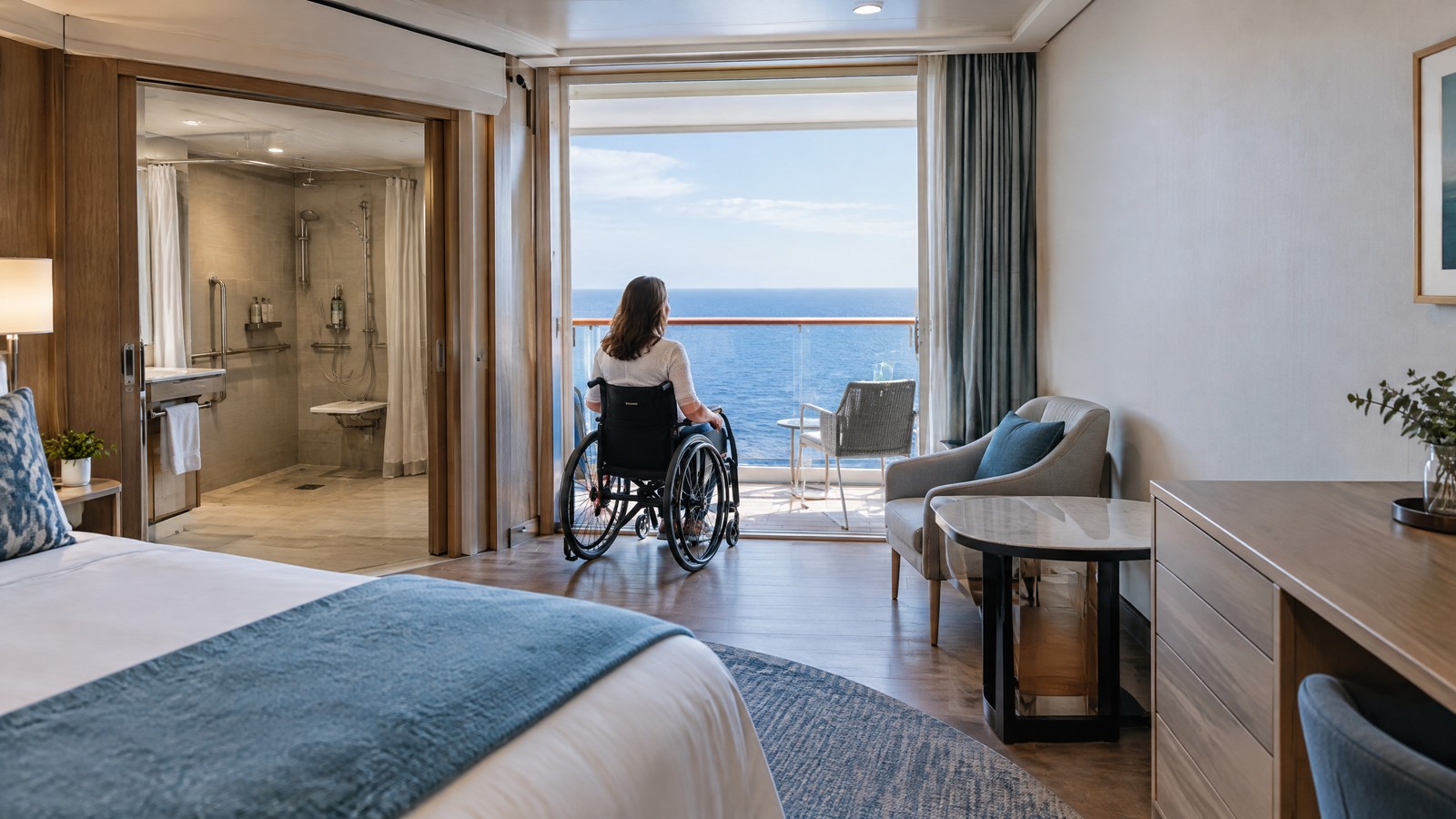
Booking an accessible cruise cabin in the UK isn’t just about finding a ship that ‘has them’. This 2026 guide shows you how to verify dimensions, request the right room early, disclose assistance and equipment needs, and avoid surprises at ports and tender stops.
If you’re searching for a cruise ship cabin for wheelchair users UK in 2026, the most important step is to verify whether a particular cabin on a specific sailing actually fits you and your mobility device. Ships differ. Two cabins with the same label on sister vessels can be laid out differently. The right approach is to measure first, ask for the ship- and cabin‑level details in writing, and reserve the appropriate accessible room early while requesting any assistance you need for UK embarkation and beyond. This guide shows you exactly how to do that, where to look for published examples, and what a cabin cannot solve—such as tender ports and personal‑care needs.
Start with verification, not assumptions
Accessible cabins vary by ship and operator. A label like “wheelchair accessible” does not guarantee that your chair fits through the door or that the bathroom layout will work for you. In 2026, the safest approach for UK travellers is to:
- Treat each ship and cabin as unique.
- Request the exact measurements and drawings for the cabin you intend to book.
- Reserve early and confirm, in writing, both the cabin and any assistance or equipment needs with the line or your agent.
Booking first and checking later can leave you relying on last‑minute swaps or cancellations, and guidance from the UK’s Maritime and Coastguard Agency (MCA) emphasises that ships are fundamentally different from buildings ashore and that adapted cabins may be limited. Always verify for your specific sailing before paying your balance.
- Measure your device: width at the widest point, overall length, turning radius, and handlebar or joystick height. Note if armrests or footplates add width.
- Identify charging needs: plug type, cable length, overnight charging time and where you can safely park without blocking a corridor.
- Ask the cruise line (or your agent) for the specific ship’s accessible‑cabin plan: cabin and bathroom door widths, ramped thresholds (if any), bathroom layout, space beside the bed, and whether a roll‑in shower is provided.
- Verify turning space in the sleeping area and bathroom. Ask for the measured clear turning diameter in both spaces.
- Check balcony access (if applicable): is there a ramped threshold and enough space to turn on the balcony? Some accessible balcony options are ship‑dependent; confirm yours.
- Confirm wardrobe and storage heights: can you reach rails and shelves? Is there space for a hoist (if applicable)?
- Put assistance requests in writing: UK port embarkation/disembarkation assistance, cabin‑setup requests, and any equipment delivery or storage. Provide deadlines and acknowledgement.
- Tender‑port reality check: shore access via tender is a separate decision. Read our guide: [Can wheelchair users go ashore at cruise tender ports? (UK, 2026)].
- Complete the operator’s special‑needs forms and keep copies. Reconfirm details 1–2 weeks before sailing.
- If anything changes (ship swap, refit, cabin move), re‑verify all dimensions before you accept the change.
What “accessible cabin” can mean in practice
The term “accessible cabin” is a category, not a guarantee of fit. Layouts can differ even within the same ship class. Some cabins have roll‑in showers; others have adapted shower‑over‑bath arrangements. Some doorways suit manual chairs but not wider powerchairs or scooters. Balcony thresholds may be ramped on some cabins but not all. UK travellers in 2026 should use the label only as a starting point and confirm the exact features for the cabin number you intend to reserve. This approach avoids relying on assumptions or generic marketing terms that do not reflect your specific needs.
- Cabin doorway width and any doorsill or lip
- Bathroom doorway width and whether it is sliding or hinged
- Turning space (diameter) in the bedroom and bathroom
- Shower type (roll‑in, fold‑down bench available, hand‑held showerhead)
- Grab bars in shower and by the toilet
- Toilet height and space for side or front transfers
- Sink height and knee space clearance
- Bed height and space under/around the bed for transfers or equipment
- Wardrobe rail height and reachable storage
- Balcony access threshold and usable clear space, if booking a balcony
- Space for charging and storing a wheelchair or scooter inside the cabin
- Location relative to lifts and accessible routes to dining and theatre
- Muster station route and any doors or ramps along the way (ask the line)
Published examples from one operator (why you must still check)
To illustrate what an operator may publish, Royal Caribbean’s UK site describes accessible staterooms that, on its ships, are designed for guests whose disability requires the associated features. It cites room sizes in a range from 14.77–27.68 sq m (159–298 sq ft) and a 1.5 m (five‑foot) turning radius in sleeping, bathroom and sitting areas. It lists vessel‑dependent stateroom and bathroom door widths of 81.3–86.4 cm, a stateroom entry with no doorsill, ramped bathroom thresholds, grab bars, lowered sinks and dressing tables, roll‑in or fold‑down shower benches, hand‑held showerheads, lowered wardrobe rods, raised toilet seats and selected accessible balconies. Royal Caribbean also says accessible suites have roll‑in showers rather than baths, with an exception on Quantum of the Seas. These details are Royal Caribbean’s own published specifications, not a UK‑wide standard, and other operators may differ. Always verify the exact features and measurements for your chosen ship and cabin with the relevant cruise line before booking in 2026.
Scooters versus manual chairs: storage, access and policy differences
Mobility scooters can create distinct cabin and routing considerations compared with manual chairs. Carnival’s accessible guidance warns that on some of its ships (including Carnival Celebration, Carnival Festivale, Carnival Jubilee, Mardi Gras and Carnival Tropicale), not all staterooms can accommodate scooters; it advises checking the ship’s accessible deck plan and confirming that your selected room meets your needs. Carnival also points guests to pre‑cruise forms and notes that requests cannot all be guaranteed. These are Carnival‑specific points that show why UK travellers should scrutinise scooter storage, turning space, and corridor access for the specific ship and cabin. For broader planning about scooters across lines, read our guide: [Can you take a mobility scooter on a cruise ship?].
Charging, parking and corridor safety (editorial guidance)
Whatever the line, scooters and powered chairs must be charged safely and parked clear of escape routes. Ask where you can charge inside your cabin and whether an extension is permitted. Do not plan to park or charge in corridors. Confirm that the cabin can contain your device fully inside with the door closed, and that you can still reach the bed and bathroom without tight, unsafe turns.
<table><thead><tr><th>Feature</th><th>Check at home</th><th>Ask the cruise line</th></tr></thead><tbody><tr><td>Mobility device width</td><td>Measure at widest point (wheels/armrests)</td><td>Exact cabin and bathroom door widths for your cabin number</td></tr><tr><td>Turning needs</td><td>Note your turning diameter and whether 3‑point turns are safe</td><td>Measured clear turning space in bedroom and bathroom</td></tr><tr><td>Thresholds</td><td>Confirm you can manage a small lip if present</td><td>Whether entry and balcony thresholds are ramped or level</td></tr><tr><td>Shower access</td><td>Decide if you require roll‑in and/or a fold‑down bench</td><td>Shower type, bench availability and grab‑bar placement</td></tr><tr><td>Toilet transfers</td><td>Preferred transfer side and needed clearance</td><td>Space beside toilet and height details</td></tr><tr><td>Bed transfers</td><td>Safe bed height for you and required space each side</td><td>Bed height and clearance on both sides of the bed</td></tr><tr><td>Storage & charging</td><td>Size of device and charging time/plug type</td><td>Space to park/charge inside the cabin without blocking exits</td></tr><tr><td>Balcony use</td><td>Whether you need step‑free balcony access</td><td>Balcony threshold design and usable space on that balcony</td></tr><tr><td>Muster/evacuation</td><td>Ability to follow crew instructions and route length you can manage</td><td>Route to muster station from the cabin and any doors/ramps en route</td></tr><tr><td>Tender ports</td><td>Comfort with steps/gaps if required</td><td>Which ports are tendered on your itinerary; request alternatives</td></tr><tr><td>Scooter policy</td><td>Overall length and turning profile of scooter</td><td>Whether your specific scooter is permitted in that cabin</td></tr></tbody></table>
When to reserve and what to disclose (UK 2026)
Adapted cabins can be limited in number and are in demand year‑round. The safest strategy is to reserve as early as possible, describe your needs accurately, and complete the cruise line’s special‑needs forms. The UK Government advises telling the cruise line, travel agent or tour operator at least 48 hours before departure when you need assistance, accommodation or specific seating/berths, including help getting on and off. In practice, many cruise lines ask for longer notice for certain services or equipment. For example, Royal Caribbean’s UK site (its policy, not a UK‑wide rule) outlines notice windows such as 60 days for sign‑language interpreting, 30 days for special‑needs equipment or services, and 72 hours for a group of passengers with a disability. Always check your operator’s current deadlines and keep written acknowledgements in 2026.
Forms, deadlines and acknowledgement
- Special‑needs forms: Complete all sections describing your device dimensions, charging needs, transfer method and assistance requests. Keep copies.
- Allocation policies: Some lines retain accessible cabins for guests who need them. Royal Caribbean says guests reserving these rooms must acknowledge the need and may be moved if evidence of misuse emerges. Policies vary—confirm yours.
- Confirmation: Ask for an email that lists your exact cabin number and confirms door widths, bathroom layout, balcony threshold and any agreed assistance or equipment delivery for your 2026 sailing.
Inside, oceanview, balcony or suite—what changes for access?
Cabin type affects layout, thresholds and usable space. Inside rooms can work well for many manual wheelchair users if the doorway, bathroom and turning space are adequate, and they often carry a lower fare. Oceanview cabins can be similar in layout to inside rooms, with a window rather than a balcony. Balconies introduce an additional threshold and may provide extra space outdoors if the threshold is ramped and the balcony is large enough to turn; always verify. Suites usually offer more floor area, which can help with turning and transfers. However, larger rooms do not automatically equate to better bathroom access. One operator’s published example: Royal Caribbean notes that its accessible suites have roll‑in showers rather than baths, except on Quantum of the Seas. This is line‑specific and does not apply to other operators by default—always check your ship.
- Inside: Often the best value if dimensions fit; no balcony threshold to manage. Space can be tighter—verify turning circles carefully.
- Oceanview: Similar to inside with natural light. Bathroom and doorway checks still critical.
- Balcony: Potentially more space and private outdoor area; must confirm balcony threshold design and usable balcony space.
- Suite: More floor area, potentially easier turns and equipment storage; not all suites are adapted, and bathroom layouts can differ—verify shower type and transfer space.
Public areas, muster and evacuation—what a cabin cannot solve
A great cabin does not guarantee access everywhere. Lifts, doorways, ramps and seating in public venues vary by ship. You should ask about the route to your muster station from your cabin, and how assistance works in an emergency. The UK Government’s guidance note (in force and relevant in 2026, though last updated January 2021) says ships must provide sufficient information to help you select and undertake a journey, and that assistance at embarkation/disembarkation is available subject to conditions and notice. It also says assistance with personal care (feeding, breathing, medication or using the toilet) may require travelling with a companion; for cruises, unlike ferries, there is no entitlement for that companion to travel free. Verify your line’s current policy and whether a companion is necessary for your needs.
Tender ports and shore excursions are separate decisions; see our 2026 article: [Can wheelchair users go ashore at cruise tender ports? (UK, 2026)].
Money‑saving without compromising access (2026)
- Book early: Adapted cabins are limited; waiting for a last‑minute fare can mean no suitable cabin remains. Early booking secures the right room first, then you can watch for permitted price adjustments.
- Be flexible on ship and date: If a preferred sailing’s accessible cabins are gone, ask your agent to search nearby dates or sister ships.
- Inside accessible value: If a balcony threshold or smaller balcony space won’t work for you, consider an accessible inside or oceanview cabin to save money while prioritising bathroom layout and turning space.
- Written confirmation avoids costly changes: A clear paper trail helps if you need to resolve a mismatch before final payment.
- Bring compact aids you already own: Portable ramps and transfer boards are sometimes helpful, but only if allowed—check with the operator first. If hiring equipment, confirm the vendor is approved by the line and that delivery is noted on your booking.
- Insurance: Choose a travel policy that recognises mobility equipment and pre‑existing conditions, and list any hired devices. This can reduce out‑of‑pocket costs if plans change.
Recommendations by traveller type (editorial guidance)
These are planning pointers rather than endorsements of a particular line. Always verify your cabin’s measurements and features for the ship you book in 2026.
- Manual wheelchair, narrow chair, minimal assistance: Prioritise exact door widths and bed/bath transfer space. Inside or oceanview cabins can be cost‑effective if the bathroom is roll‑in or otherwise workable for you.
- Powerchair user needing generous turning: Ask for measured turning circles in bedroom and bathroom and a roll‑in shower. Larger accessible balcony cabins or adapted suites may help—but verify thresholds and shower details.
- Mobility scooter user: Confirm scooter length/width, storage and charging inside the cabin. Some operators (e.g., Carnival on named ships) indicate not all staterooms can accommodate scooters, so use accessible deck plans and get written approval for your specific scooter.
- Can transfer to shower seat but not step over a bath: Insist on a roll‑in or step‑free shower with a bench; avoid cabins described as shower‑over‑bath unless you have verified access.
- Needs companion for personal care: Book early for proximity to lifts and verify space for two people to move comfortably. Confirm the muster route and accessible seating in dining/theatre areas.
- Family booking two cabins: Request adjacent or connecting cabins, one of which is adapted, and confirm door widths on both rooms. Ensure the accessible room is assigned to the person who needs it for allocation purposes.
- Device fit first: If your device won’t pass the cabin or bathroom door, pick another cabin or sailing.
- Shower access next: If you need roll‑in, don’t compromise; seek a cabin where this is confirmed in writing.
- Thresholds: If balcony access matters, verify the exact threshold design for your cabin number.
- Turning space: Ask for measured turning diameters in both bedroom and bathroom.
- Storage and charging: Confirm a safe charging location inside the cabin and parking space that doesn’t block exits.
- Route to venues: Choose a location near lifts on an accessible route to dining and theatre.
- Paper trail: Ensure your booking file contains your confirmed measurements, assistance requests and equipment notes.
How to read accessibility pages and deck plans
Start with your operator’s accessibility portal. Royal Caribbean’s UK pages outline accessible cruising and accessible staterooms with examples of door widths, turning spaces and features. Carnival’s pages include accessible route information and, where available, interactive deck plans with details for particular staterooms. Use these as a foundation, but do not stop there—ask for cabin‑specific confirmation for your 2026 sailing. If you are sailing with a UK‑focused brand such as P&O Cruises, Cunard or Marella, request the same level of detail from the line or your agent, including door measurements and bathroom layouts for the exact cabin number before you commit.
Questions to put in writing to your agent or cruise line
- What are the cabin and bathroom door widths for cabin [number] on [ship]?
- Is the cabin entry threshold level, and is any balcony threshold ramped?
- What is the measured turning diameter in the sleeping area and bathroom?
- Is the shower roll‑in, and is there a fold‑down bench and hand‑held showerhead?
- What space and height are available for toilet transfers? Which side has more clearance?
- What is the bed height and clearance on each side?
- Where can I store and charge my wheelchair/scooter inside the cabin?
- What is the route to the muster station from this cabin, and are there heavy doors or ramps?
- Are there any scooter restrictions for this ship or cabin?
UK embarkation: getting to and through the terminal
Plan your route from home to port with time to spare. For Southampton—where many UK cruises begin—read our detailed Southampton Cruise Terminal Accessibility Guide. The UK Government advises notifying the cruise line, travel agent or tour operator at least 48 hours in advance if you need assistance, including help to get on and off the ship. Provide your sailing date, terminal, device dimensions and any transfer needs in writing, and carry confirmation to the port in 2026.
Re‑check before you pay the balance—and again before you sail
Ships can be switched, cabins reassigned and rooms refurbished. Before your final payment in 2026, ask the line to reconfirm your exact cabin number and the key measurements you rely on. If anything has changed, request alternatives that meet your needs. One to two weeks before sailing, re‑confirm assistance and any equipment delivery times, and keep the confirmation email handy for embarkation.
Context: why this planning matters in 2026
The UK Department for Transport/Maritime and Coastguard Agency’s disabled passenger satisfaction survey (published 2023 and reflecting journeys from late 2021 to 2022) reported that some respondents who had not cruised in the preceding year cited difficulty getting around ships or boarding/disembarking as reasons. The survey was voluntary and not representative of all maritime passengers, but it underlines why cabin choice and assistance planning matter. In 2026, the best response is to verify your exact cabin features, arrange assistance early, and separate cabin decisions from port/tender considerations.
Link your planning with our related 2026 guides
- Cabin research hub: [Accessible Cruise Cabin Guide for UK Travellers 2026]
- Equipment: Can you take a folding wheelchair on a cruise ship? (UK, 2026)
- Scooters: [Can you take a mobility scooter on a cruise ship?]
- Tender ports: [Can wheelchair users go ashore at cruise tender ports? (UK, 2026)]
- Terminals: [Southampton Cruise Terminal Accessibility Guide]
- Cabins explained: Cruise cabin types explained
- Wider needs: Cruise with Dementia: UK Planning Guide 2026 and Cruise with Autism: UK Guide 2026.
Sources and verification
Before you book in 2026, verify your ship and cabin details on the operator’s official site and keep confirmations in writing. Official pages used for this guide include:
- Royal Caribbean International — Accessible Cruising (UK): https://www.royalcaribbean.com/gbr/en/experience/accessible-cruising
- Royal Caribbean International — Accessible Staterooms (UK): https://www.royalcaribbean.com/gbr/en/experience/accessible-cruising/accessible-staterooms
- Carnival Cruise Line — Wheelchair Users / Facilities and Services for Guests with Disabilities: https://www.carnival.com/about-carnival/special-needs/wheelchair-users
- UK Government — Transport support services for disabled people: Ships: https://www.gov.uk/transport-disabled/ships
- UK Government / MCA — Guidance for disabled passengers and passengers with reduced mobility when travelling by ship (Guidance note 5, last updated 26 January 2021; confirm current guidance in 2026): https://www.gov.uk/government/publications/draft-guidance-notes-relating-to-regulation-eu-no-1177-2010/guidance-for-disabled-passengers-and-passengers-with-reduced-mobility-when-travelling-by-ship-guidance-note-5
- UK Government — MCA disabled passenger satisfaction survey 2023 (context only; not representative): https://www.gov.uk/government/publications/mca-disabled-passenger-satisfaction-survey-2023/mca-disabled-passenger-satisfaction-survey-2023
Cabin choice is central to accessible cruising; continue with our best cruise line for disabled passengers guide.
Frequently Asked Questions
Do UK cruise lines guarantee me an accessible cabin if I ask for one?
No. Adapted cabins are limited and must be reserved. Book as early as possible, complete the line’s special‑needs form, and get written confirmation of the exact cabin number and its key measurements in 2026. Policies vary by operator—verify on the official site before paying.
What cabin door width do I need for my wheelchair or powerchair?
It depends on your device. Measure the widest point (including armrests/joystick) and ask the line for the exact cabin and bathroom door widths for your chosen cabin. As an example from one operator, Royal Caribbean publishes accessible stateroom/bathroom door widths in the range of about 81.3–86.4 cm on its ships, but this is not a UK‑wide standard. Always confirm your ship and cabin.
Can I bring a mobility scooter into a standard cabin?
Maybe—but do not assume. Carnival cautions that on some ships, not all staterooms can accommodate scooters and advises checking accessible deck plans and confirming your selected room. Across all lines, you must be able to park and charge inside the cabin without blocking exits. Read our 2026 guide: Can you take a mobility scooter on a cruise ship?.
Are accessible balconies fully step‑free?
Not universally. Some cabins have ramped thresholds; others may have a lip. Royal Caribbean notes “selected accessible balconies,” but specifics vary by ship. Ask for the balcony threshold design and clear space for your exact cabin number in 2026 and get it confirmed in writing.
Do I need to travel with a companion for personal care?
UK Government guidance (relevant in 2026) says that assistance with personal care such as feeding, breathing, medication or using the toilet may require travelling with a companion. For cruises there is no entitlement for that companion to travel free. Check the operator’s current policy before booking.
How early must I request assistance and equipment?
Tell your line, agent or tour operator at least 48 hours before departure if you need help getting on/off or specific accommodation (UK Government guidance). Some operators ask for more notice for services. For example, Royal Caribbean lists 60 days for sign‑language interpreting, 30 days for special‑needs equipment/services, and 72 hours for a group of passengers with a disability. Verify current deadlines for your 2026 sailing.
How do I verify a specific cabin will work for me?
Measure your device, then ask the line for the exact cabin and bathroom door widths, turning space, shower type, toilet transfer space, bed height/clearance and any balcony threshold for that cabin number. Request drawings or photos with measurements and keep confirmations in writing.
Can the cruise line move me if I book an accessible cabin?
Policies vary. Royal Caribbean says accessible rooms are for guests who need the features and that it may move a booking if there is evidence of misuse. The safest course is to accurately disclose your needs on the special‑needs form and keep written confirmation for your 2026 sailing.
Does a great accessible cabin mean I can tender ashore?
No. Cabin access and tender access are separate decisions. Many tender operations involve steps or gaps that may not be suitable for some devices or travellers. Confirm each port in advance and read our 2026 guide: Can wheelchair users go ashore at cruise tender ports? (UK, 2026).
Where should I start my research?
Begin with our hub: Accessible Cruise Cabin Guide for UK Travellers 2026. Then check your line’s official accessibility pages and request cabin‑specific measurements for your intended sailing. Re‑verify details before you pay the balance.
Related articles
- Cruise Cabin Types Explained: Inside, Outside, Balcony & Suite
- Can you take a mobility scooter on a cruise ship (UK)?
- Southampton Cruise Terminal Accessibility Guide 2026
- Accessible Cruise Cabin Guide for UK Travellers 2026
- Cruise With Autism UK Guide 2026: Practical Planning
- Can wheelchair users go ashore at cruise tender ports (UK, 2026)?
- Cruise with dementia UK: planning guide 2026
- Can you take a folding wheelchair on a UK cruise in 2026?