Home › Articles › Accessibility
Best Cruise Line for Disabled Passengers UK (2026)
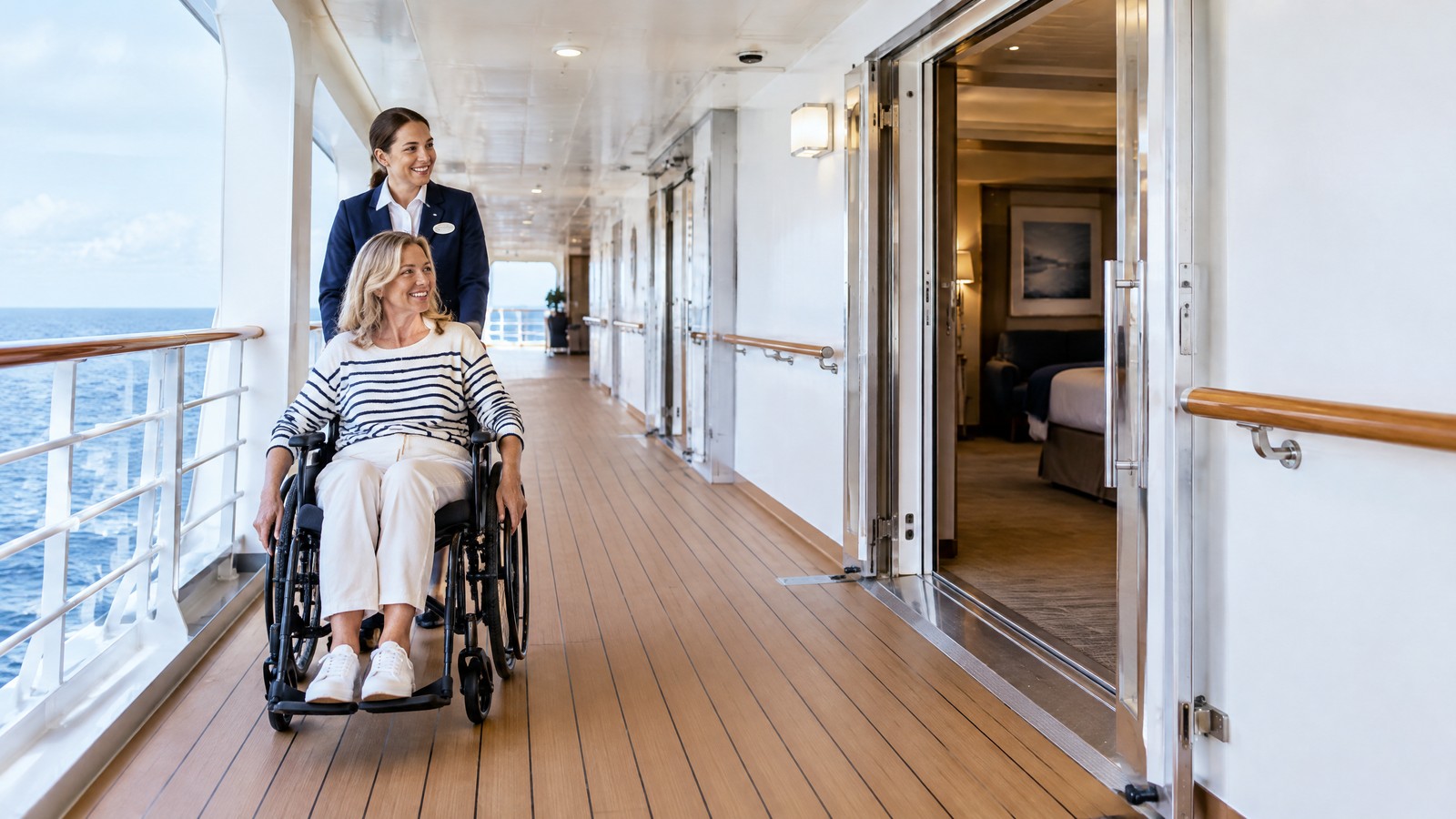
There isn’t one “best” cruise line for every disabled passenger. The right choice is the exact ship, cabin and itinerary that can confirm your assistance, equipment and shore-access plan in writing. Use this UK-focused 2026 guide to shortlist operators and ask the right questions before you book.
If you’re searching for the best cruise line for disabled passengers UK, the most useful answer in 2026 is also the most honest: there’s no single winner for everyone. What works brilliantly for a wheelchair user who needs a roll-in shower and space for a scooter may not suit a traveller with a hearing impairment who prioritises communication support or someone who needs a low‑stimulation embarkation. The safest way to choose is to match one person’s functional needs to a specific ship, accessible cabin and itinerary, and get written confirmation of the assistance and equipment plan before you pay the balance.
What makes a cruise line suitable (for you)
A cruise line becomes suitable when the practical pieces line up for the exact trip you intend to take. Look for: a confirmed cabin that matches your transfers and bathroom needs; acceptance (in writing) of your mobility device and any medical equipment; a realistic embarkation and disembarkation plan at the UK port you’ll use; a route with shore days you can access safely (including tender ports); and clarity on what assistance is and is not provided by the crew. That turns a broad accessibility promise into a trip you can actually take.
Your UK cruise passenger support rights—and what they don’t guarantee
As at 2026, GOV.UK advises disabled passengers and people with reduced mobility to inform the cruise line, travel agent or tour operator at least 48 hours before departure if you need assistance or specific arrangements for getting on and off a ship. Assistance should be provided free of charge where the conditions apply, and if something goes wrong you should first complain to the cruise company; if unresolved in England and Wales, the GOV.UK page directs you to CLIA. Government guidance also says to disclose accommodation, seating, service and medical‑equipment needs when booking if you already know them, and it cautions that adapted cabins may be limited. If you give less than 48 hours’ notice, you may still receive reasonable efforts but not a guarantee. None of this is a promise that every device, itinerary or port can be accommodated—safety requirements, ship design, port infrastructure, weather, tides and tender operations can limit what’s possible. If you are refused carriage or shore access because of safety or feasibility, the official guidance describes the reasons and alternative‑sailing information that should be provided; you can request a written explanation. Always check the current guidance and your cruise line’s own rules before booking.
Choose by need, not by diagnosis
Disability is not a single set of requirements. Two people with the same diagnosis might need very different cabin layouts, transfer options, assistance timings and sensory environments. Start by writing down what you must be able to do safely and comfortably each day of the trip—on board, in the terminal and ashore—without disclosing more medical information than is necessary to arrange your support. Then use operator accessibility pages to see which ships and processes are most likely to fit, and verify every element for your chosen sailing.
Mobility and cabin layout
List the transfers you can and cannot do, plus bathroom features you rely on. Examples: step‑free routes; a roll‑in or transfer shower; a fold‑down shower seat; grab rails; a raised toilet; clearance for side or front transfers; bed height or space for a hoist; and doorway width. Ask the line for a cabin‑specific accessibility specification or deck‑plan notes where available, and request written confirmation that the exact cabin number you are being assigned is appropriate for your device and transfers.
Wheelchair or scooter considerations
Think about where you need your device: only around the ship, or also inside the cabin and bathroom? Some operators publish explicit rules that affect this decision. For example, P&O states that a full‑time wheelchair or mobility‑scooter user—or a guest who needs a device inside the cabin—must be booked into a suitable accessible cabin or certain suite types, and it asks that mobility equipment be declared at booking (or as soon as known) with folded or smallest dimensions; late‑declared equipment is subject to availability and undeclared equipment cannot be taken on board. Those are P&O‑specific rules, not industry‑wide standards, so always check the operator’s website for your chosen sailing and have acceptance confirmed in writing.
Vision, hearing, communication and sensory needs
Tell the line what helps you: for example, tactile or braille signage use, printed or digital daily schedules, hearing loops at check‑in, captioning where available, or a quieter embarkation route. Some lines publish notice periods for certain services (for instance, a UK site may cite a multi‑week notice window for sign‑language interpreting or equipment requests). Treat those as line‑specific examples rather than cross‑industry promises, and give as much notice as you can so the team can plan. On board, you can also request practical way‑finding support or to meet at a designated assistance point at agreed times.
The five things to confirm before booking
Before you lock in a sailing, turn your shortlist into a documented plan. Do not rely on a marketing page or a generic accessibility statement. Ask the line (or your agent) to answer the same practical questions in writing and to note them on your booking.
- Cabin suitability: Is the specific cabin category and cabin number compatible with your device, transfers and bathroom needs? Request a ship‑specific accessibility specification or deck‑plan notes if available. 2) Equipment approval: Has the line accepted your mobility aid and any medical equipment? Provide dimensions, weight, folded size and battery/power details only through the operator’s secure process. 3) Terminal and boarding assistance: What help is confirmed from drop‑off through check‑in, security, gangway, cabin access and disembarkation? Ask for the exact meeting point and arrival time. 4) Itinerary access: Which calls use tenders or might otherwise be difficult? What are the mobility requirements for boarding the tender and for any proposed excursion? 5) Shore transport: Which experiences use step‑free or accessible transport, and what are surface/gradient, transfer and accessible‑toilet arrangements? Treat availability as itinerary‑specific. 6) Emergency planning: What is the plan in an emergency for you and your equipment? This is a planning question, not a request to override safety procedures. 7) Personal care: If you need help with personal care or lifting, does the line require you to travel with a companion? Do not assume crew provide these tasks.
<table><thead><tr><th>Traveller need (example)</th><th>P&O Cruises</th><th>Cunard</th><th>Royal Caribbean</th><th>Princess Cruises</th></tr></thead><tbody><tr><td>Uses a wheelchair/scooter inside the cabin</td><td>Check P&O’s rule that full‑time wheelchair/scooter users or guests needing a device in‑cabin must book a suitable accessible cabin or certain suites. Declare equipment early.</td><td>Use the on‑board‑needs questionnaire early to establish what can/can’t be accommodated; then confirm a specific accessible cabin.</td><td>Ask about accessible staterooms and device acceptance on your ship; some services have stated advance‑notice examples on the UK site.</td><td>Use the accessible stateroom feature checklist (e.g., wider doors, roll‑in/transfer shower). Confirm your exact cabin and device clearance.</td></tr><tr><td>Requires sign‑language interpreting or certain equipment/services</td><td>Ask what’s possible for your sailing and notice period required.</td><td>Use the questionnaire process to discuss feasibility and timing.</td><td>UK site cites example notice periods (e.g., multi‑week) for certain services. Treat as line‑specific and confirm for your date/ship.</td><td>Ask the access team what notice and options apply on your ship/itinerary.</td></tr><tr><td>Worried about tender ports</td><td>Request a list of tender calls and mobility requirements for transfers.</td><td>Discuss tender feasibility via the needs questionnaire before booking.</td><td>Ask how tenders are handled on your itinerary; verify each port.</td><td>Princess cautions that tender/water‑shuttle access can be impossible for some users; captain decides. Verify port by port.</td></tr><tr><td>Prefers a UK‑style no‑fly departure (e.g., Southampton)</td><td>Check ship, terminal and assistance meeting point; complete forms early.</td><td>Confirm terminal arrangements and timings alongside the questionnaire.</td><td>Verify terminal assistance and arrival time with the UK contact centre.</td><td>Confirm terminal access, then review cabin features against the checklist.</td></tr><tr><td>Travelling with medical equipment</td><td>Declare equipment dimensions/power at booking or when known; late‑declared items are subject to availability and undeclared items cannot be taken.</td><td>Use the questionnaire to establish what can be carried and how.</td><td>Ask about special‑needs equipment notice windows and ship‑specific acceptance.</td><td>Confirm permitted devices and cabin layout suitability for safe use/storage.</td></tr></tbody></table>
Official operator examples for a UK shortlist (verify per sailing)
Use official accessibility pages to build a shortlist—then test each option against your needs on your dates. The examples below are not a ranking, and they don’t confirm availability for your sailing. Always verify on the line’s website and in writing before you book.
P&O asks guests to disclose assistance needs at booking and to complete its on‑board‑needs questionnaire as soon as possible, no later than two weeks before sailing. Its accessible‑cabin page says a full‑time wheelchair or mobility‑scooter user, or a guest needing a device inside the cabin, must be booked into a suitable accessible cabin or certain suite/mini‑suite types. P&O also notes that while most public areas have level or ramped access, ships can include heavy doors, raised thresholds and some narrower areas. Mobility equipment must be declared at booking or as soon as known, with folded/smallest dimensions; late‑declared equipment is subject to availability and undeclared equipment cannot be taken on board. Check your exact ship and itinerary with P&O before booking. For itinerary ideas, see our planning guide P&O Iona Itineraries from Southampton 2026 and then verify terminal and cabin details with P&O directly.
Cunard asks guests to complete its on‑board‑needs questionnaire as soon as possible, and no later than two weeks before sailing. Cunard frames this as a way to establish what the line can and, in some cases, cannot accommodate. That clarity helps you decide before you commit. Check the exact ship, cabin and itinerary with Cunard before booking. If you’re also comparing brands for style and itineraries rather than accessibility alone, our overview [Cunard vs Celebrity Cruises UK] can help you frame questions—then confirm accessibility with Cunard’s team.
Royal Caribbean’s UK accessibility page lists example notice periods for selected services—for instance, 60 days for sign‑language interpreting, 30 days for certain special‑needs equipment or services, and 72 hours for groups of 10 or more passengers with a disability. These are service‑specific examples from Royal Caribbean, not a substitute for the UK’s 48‑hour assistance notification guidance or another operator’s rules. Insufficient notice means requested support is not guaranteed. Verify your exact needs, ship and sailing with the Royal Caribbean UK team before booking. For a sense of broader brand differences (not accessibility claims), see [P&O vs Royal Caribbean: Which Is Better?] and then go back to Royal’s accessibility team for sailing‑specific answers.
Princess describes fully accessible staterooms as having wider doors and bathrooms with either a roll‑in or a transfer shower, a fold‑down bench, an alarm, a handheld showerhead and grab bars. Princess also warns that accessibility varies globally and tender or water‑shuttle access can be impossible for some mobility‑device users; the captain makes the safety decision on the day. Those points make Princess a useful candidate if the published stateroom features align with your needs and the itinerary’s tender days are workable. Always check the exact ship, cabin and itinerary with Princess before booking. If you want a broader feel for the line’s style, you can read our [Princess Cruises Review UK 2026] and then verify accessibility specifics with Princess directly.
Ports: Southampton start and getting ashore
Your trip involves at least three stages: getting to the UK terminal, getting onto the ship, and getting ashore in each port. For Southampton departures, the Visit Southampton guidance states that terminals offer step‑free access, accessible toilets, designated seating, hearing loops and close drop‑off zones, and it recommends contacting your cruise operator at least 48 hours ahead for mobility support or boarding assistance. Treat this as terminal information rather than confirmation that your cruise‑line request has been accepted; you still need the line to confirm your meeting point, time and assistance plan in writing. A no‑fly departure can simplify travel for some passengers, but it doesn’t remove the need to verify gangway gradients, tender usage and the cabin’s suitability.
- Confirm the exact terminal for your sailing and any arrival‑time instructions from the line.
- Ask where the assistance desk is, whether you need to check in there first, and what identification you should show.
- Verify who will assist you from the drop‑off/parking bay through security, the gangway and to your cabin.
- Request a list of tender ports and any mobility requirements for boarding the tender, including the number of steps, transfer expectations and whether devices can travel.
- For each planned shore experience, ask about vehicle access (step‑free or ramped), route surface/gradient, transfer needs and accessible‑toilet locations.
- If weather or tides could affect safe access, ask what the alternatives are and how they’re communicated on the day.
Medication, equipment and travel documents
If you travel with medicines or medical equipment, a little paperwork can prevent a lot of stress. NHS advice supports preparing well ahead, keeping medicines in original pharmacy packaging, and carrying both a prescription and a prescriber’s letter that covers generic names, dosages and the need for the medicine or device. Allow extra supplies in case of delays or lost luggage, and check any destination rules for controlled or temperature‑sensitive medicines. Operator approval for oxygen and other equipment is always ship‑ and sailing‑specific; follow the cruise line’s own process for disclosures and acceptance, and ask for written confirmation.
- Keep medicines in original labelled packaging and in your hand luggage where possible.
- Carry your prescription and a clinician’s letter that explains what each medicine/device is for and any storage requirements.
- Bring enough supply for delays, plus a small buffer.
- Check destination rules for your medicines well before departure.
- Share device dimensions, weight and power/battery details with the cruise line only via its secure process and within its stated timelines.
- Ask for written confirmation of accepted equipment, how it will be stored/charged, and any restrictions during tender operations or emergency drills.
Booking checklist and final verdict
Before you commit, bring all the strands together. Ask the line to reconfirm your cabin number, equipment approval reference and assistance plan on the booking in writing, and save copies. If you’re choosing between brands for overall style and routes, see our context pieces Best Cruise for Wheelchair Users UK 2026 and [Cunard vs Celebrity Cruises UK], then return to the operator’s accessibility team with ship‑and‑date‑specific questions. The editorial bottom line for 2026: for many UK passengers, the “best” cruise line is the one that confirms a suitable cabin, accepts the required equipment and assistance, and sails an itinerary with workable port access—not the one with the broadest marketing claim.
- Exact cabin number and written statement that it fits your transfers, bathroom needs and device.
- Written acceptance of mobility aids and medical equipment (with dimensions/power noted).
- Confirmed terminal assistance: location, arrival time and contact point.
- List of tender ports with the line’s mobility requirements for boarding and any restrictions for devices.
- Shore‑day notes: transport type, surfaces/gradients, transfer expectations and accessible‑toilet access.
- Emergency planning note specific to you (for awareness, not to override safety procedures).
- Clarified personal‑care expectations (crew do not provide lifting/personal care unless the line explicitly says so) and companion requirement if applicable.
- Copy of the completed on‑board‑needs questionnaire and any correspondence with the access team.
Sources and verification (check before you book)
Review the live pages below for the most current 2026 details and ship‑specific rules: GOV.UK Transport support services for disabled people: ships — https://www.gov.uk/transport-disabled/ships. GOV.UK Guidance for disabled passengers and passengers with reduced mobility when travelling by ship — https://www.gov.uk/government/publications/draft-guidance-notes-relating-to-regulation-eu-no-1177-2010/guidance-for-disabled-passengers-and-passengers-with-reduced-mobility-when-travelling-by-ship-guidance-note-5. GOV.UK Guidance for carriers, tour operators and travel agents on carriage of disabled passengers — https://www.gov.uk/government/publications/draft-guidance-notes-relating-to-regulation-eu-no-1177-2010/guidance-for-carriers-tour-operators-and-travel-agents-on-the-carriage-of-disabled-passengers-and-others-with-reduced-mobility-guidance-note-2. P&O Cruises Accessibility — https://www.pocruises.com/accessibility. P&O Accessible cabins and ship access — https://www.pocruises.com/accessibility/life-onboard/accessible-cabins-and-ship-access. P&O Mobility aids and equipment — https://www.pocruises.com/accessibility/life-onboard/mobility-equipment. Cunard UK Your on board needs — https://www.cunard.com/en-gb/accessibility. Royal Caribbean UK Accessible cruising — https://www.royalcaribbean.com/gbr/en/experience/accessible-cruising. Princess Cruises UK Accessibility at sea — https://www.princess.com/en-uk/accessibility-at-sea. Visit Southampton Cruise FAQ — https://www.visitsouthampton.co.uk/cruise/faq/. NHS Medicines and travel — https://www.nhs.uk/common-health-questions/medicines/can-i-take-my-medicine-abroad/.
Frequently Asked Questions
Is there one best cruise line for disabled passengers in the UK?
No. There is no official evidence that one line is best for everyone. The right choice is the exact ship, cabin and itinerary that can confirm your assistance and equipment plan in writing for your dates. Treat brand marketing as a starting point, not a guarantee.
How far ahead should I tell a cruise line that I need assistance?
GOV.UK advises telling your cruise line, agent or tour operator at least 48 hours before departure if you need assistance or specific arrangements to get on or off a ship. Many lines also ask you to disclose needs at booking and complete an on‑board‑needs questionnaire as soon as possible. Some services on certain lines have longer notice windows. With less than 48 hours’ notice, you may receive reasonable efforts but not a guarantee—always check the operator’s own requirements.
Can I take my wheelchair or mobility scooter on a cruise?
Often yes, but rules vary by operator and ship. For example, P&O asks that mobility equipment be declared at booking (or as soon as known) with folded or smallest dimensions, and it states that undeclared equipment cannot be taken on board. Some lines require guests who use a wheelchair or scooter inside the cabin to book an accessible cabin. Always check your line’s rules and obtain written acceptance for your sailing.
Are accessible cabins always available on every sailing?
No. Government guidance cautions that adapted cabins may be limited. Availability depends on the ship, sailing date and who has already booked. Book early, confirm the exact cabin number and get written confirmation that the room suits your device and transfer needs before you pay the balance.
Can wheelchair users go ashore at tender ports?
Sometimes, but it depends on the tender arrangements, weather, sea conditions, the ship’s equipment and your ability to transfer safely. Princess explicitly cautions that tender access can be impossible for some mobility‑device users and that the captain makes the safety decision on the day. Ask your line to identify tender ports and describe the mobility requirements for boarding. Treat each port as itinerary‑specific.
Will cruise staff provide personal care or lifting?
Do not assume crew provide personal care, lifting or medical administration. If you need such support, ask the operator whether a companion is required and what staff can and cannot do. Get this clarified in writing before booking.
What should I bring if I travel with medication or medical equipment?
NHS advice is to keep medicines in original pharmacy packaging, carry your prescription and a prescriber’s letter, bring more than you need in case of delays, and check destination rules for your medicines. For equipment, share dimensions, weight and power/battery details through the operator’s secure process and obtain written acceptance for your ship and date.
What if my assistance request is refused or doesn’t work on the day?
Safety, ship design, port infrastructure, weather and tides can limit what’s possible. If refusal is connected with disability or reduced mobility, GOV.UK guidance describes reasons and alternative‑sailing information that should be provided; you can request a written explanation. Raise issues with the cruise company first; for unresolved assistance complaints in England and Wales, the GOV.UK page directs you to CLIA.
Is a no‑fly UK departure (like Southampton) easier for disabled travellers?
It can reduce the moving parts in your journey, but it doesn’t remove the need to confirm terminal assistance, gangway arrangements, cabin suitability and tender‑port access. Visit Southampton lists step‑free access, accessible toilets, designated seating, hearing loops and close drop‑off zones at its cruise terminals; still, confirm your exact terminal and meeting point with your operator.
Where can I compare cruise lines for style and itineraries before I focus on access?
Use round‑ups as context, then return to the line’s accessibility team for sailing‑specific answers. For example: P&O vs Royal Caribbean: Which Is Better?, Princess Cruises Review UK 2026 and Cunard vs Celebrity Cruises UK. These do not replace official accessibility pages or written confirmations.
Related articles
- P&O Iona itineraries from Southampton 2026: Complete Guide
- Best cruise for wheelchair users UK 2026: top accessible ships
- Princess Cruises review UK 2026: A detailed guide
- Cruise Travel Insurance UK Best 2026: Top Cover Picks
- Cunard vs Celebrity Cruises UK: Which Is Best for You?
- P&O vs Royal Caribbean: Which Is Better in 2026?