Home › Articles › Accessibility
Cruising with a Mobility Scooter from the UK: Book Smart
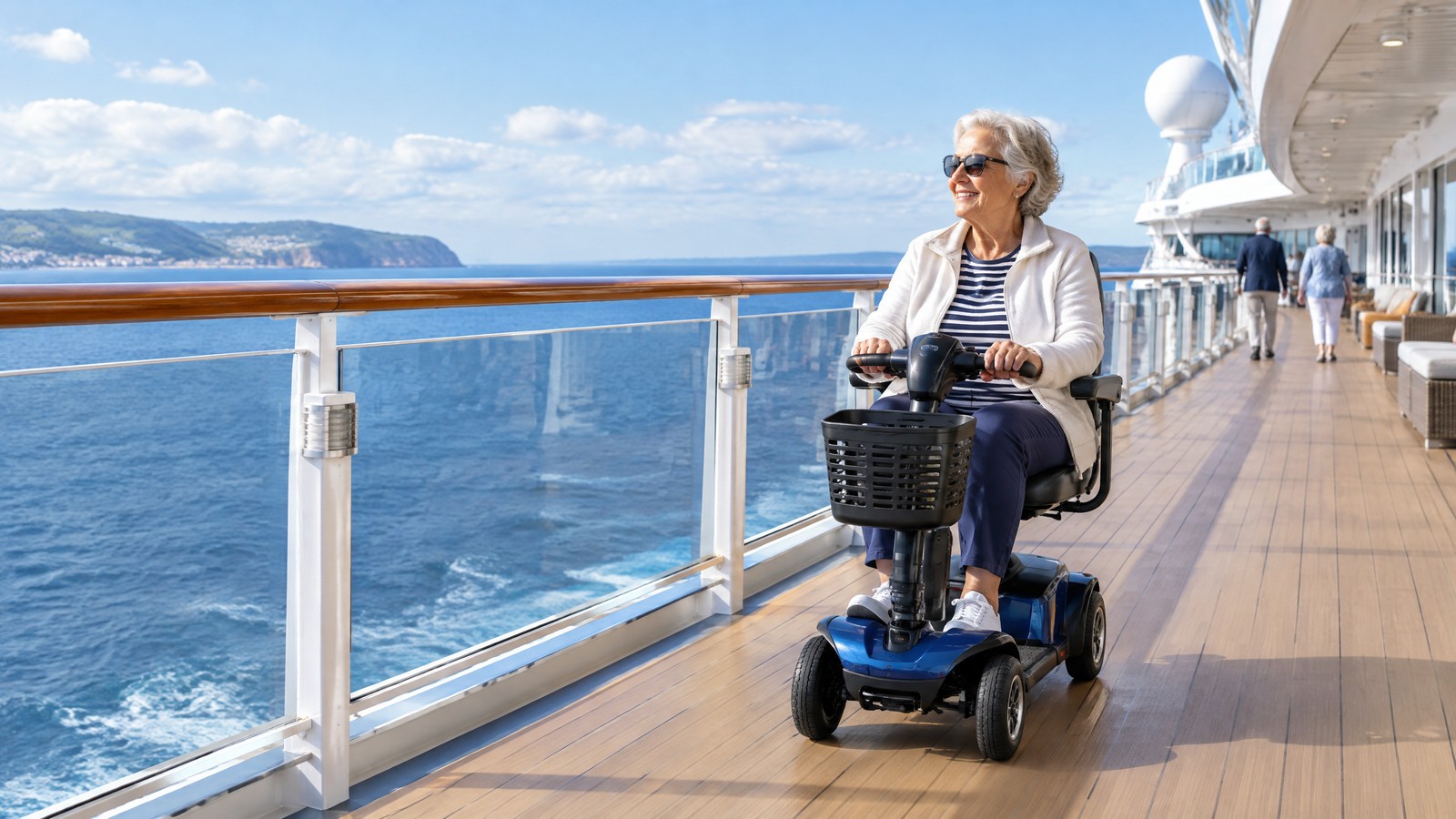
You can cruise from the UK with a mobility scooter, but only if your exact device, cabin and itinerary are confirmed as safe and practical by the operator. Use this guide to measure your scooter, match it to the right cabin, confirm battery and charging rules, plan UK embarkation help and audit tender ports—before you pay a deposit.
Can you cruise with a mobility scooter from the UK? In many cases, yes—but only when your exact scooter, cabin, battery and itinerary are individually approved. This guide explains the checks to make before you put down a deposit, using official UK guidance and named cruise-line examples to show why the decision is sailing-specific. We’ll also help you match your scooter to the right cabin, plan UK embarkation assistance, understand tender-port limits, and prepare the questions to send your cruise line or agent so you can book with confidence.
The five checks before you book
A scooter-friendly cruise is built on five decisions made in the right order. First, identify the exact device: note its manufacturer/model, full dimensions (open and folded), total weight, turning needs, battery chemistry and charger specification. Second, choose an exact ship and itinerary, then send those device details at booking; a general brand policy is not a green light for your sailing. Third, reserve a cabin category the line confirms can store and charge your scooter in-cabin with doors, bathroom access and evacuation routes kept clear. Fourth, confirm battery and charging rules in writing, including whether charging must be attended and whether your charger is voltage/Hz-compatible. Fifth, audit every port—especially tender calls—and ask about the current access plan for your dates; acceptance onboard does not guarantee going ashore.
- Record exact scooter details: make, model, open/folded dimensions, total weight, battery type, charger input, turning needs, and whether you can transfer.
- Pick a ship and itinerary, then declare the device at booking and complete the operator’s accessibility/medical form.
- Secure a cabin the line confirms as suitable for storage and charging—don’t assume a standard cabin will fit.
- Get battery/charger instructions in writing from the cruise line; don’t rely on forum advice.
- Audit gangways and tender ports for your exact sailing, then check excursions and transfers separately.
Tell the cruise line about the scooter at booking
UK government advice says help is available for disabled passengers on UK-departing ships, and you should tell the cruise line, ferry operator, travel agent or tour operator about required assistance at least 48 hours before departure. That is a national baseline for requesting help—not a guarantee that any scooter or tender will be accepted. Individual cruise lines often set earlier deadlines and require specific forms. For example, P&O Cruises asks guests bringing a powered mobility device to declare it at booking or as soon as the need is known, provide folded or smallest-state dimensions, and complete its On-Board Needs Questionnaire as soon as possible after booking and no later than two weeks before departure. MSC Cruises asks guests to specify battery type (gel, dry or lithium) in advance and warns that late/undeclared equipment can be denied boarding. These are operator examples, not universal rules. Always follow your chosen line’s current instructions for your ship and sail date and keep confirmations in writing.
- Exact make and model; a retailer’s “cruise-friendly” label is not sufficient.
- Dimensions in the smallest/folded state and total weight with battery.
- Battery chemistry (for example, gel, dry, lithium) and whether the battery can be removed.
- Charger input specification (voltage and Hz) from the manufacturer plate/manual.
- Whether you need an accessible bathroom and whether you can transfer.
- Any planned assistance at the UK terminal and during embarkation.
- A request for the line’s current accessibility/medical form and written confirmation for your exact sailing.
Measure the scooter and match it to the cabin
Do not assume a standard stateroom will fit and charge a powered scooter. Ask the cruise line to confirm which cabin categories on your chosen ship can store your exact device inside the cabin with a clear evacuation route. As an operator example only, Royal Caribbean publishes a standard stateroom entry doorway of at least 58.4 cm and an accessible-stateroom doorway of at least 81.3 cm, and requires storage and charging in the stateroom so corridors remain clear. Those figures and procedures apply to Royal Caribbean’s fleet information—not to other lines or a guarantee for a particular ship or cabin. If you need help choosing between accessible bathrooms, turning circles and bed heights, our cabin articles give decision frameworks: see Accessible cruise cabin guide and Choosing a cruise ship cabin for wheelchair users (UK).
Battery and charging: get the line’s instruction, not forum advice
Identify your battery chemistry and charger requirements in writing. Cruise lines set their own acceptance rules. As an example, MSC Cruises asks guests to state whether a scooter’s battery is gel, dry or lithium and says wet batteries are not permitted on its ships. P&O Cruises tells guests to store and charge the device in the cabin, to attend charging while in the cabin, and to check with the equipment manufacturer or supplier that the charger is safe to use at 60 Hz and voltage-compatible. These are operator-specific examples you must not generalise across brands. Always ask your booked line whether your battery and charger are accepted, where and how charging will be done, and whether any ship-specific electrical restrictions apply on your sailing.
Embarkation from a UK port: arrange assistance early
If you need help getting to the ship, through the terminal and onto the gangway, request it at the time of booking and reconfirm before you travel. GOV.UK sets a national benchmark of telling the cruise line or travel provider at least 48 hours before departure when you require assistance, but your operator may set earlier deadlines or require a dedicated form. Follow the exact reporting point and arrival time on your ticket; terminals can have specific routes for assisted boarding. For port-specific detail, see our Southampton cruise terminal accessibility guide. Do not assume staff can lift you or your scooter; as an example, Royal Caribbean notes that crew members may not lift assistive devices. Ask your line what support is provided at your terminal for your sailing and how the scooter will be handled at the gangway.
Ports, gangways, tenders and excursions
A ship accepting a scooter does not guarantee you can go ashore everywhere. Access at each call depends on dock availability, gangway angle, local safety rules, weather and tides. Tender ports are a separate decision. Royal Caribbean states that motorised wheelchairs and mobility scooters cannot be taken on tenders unless roll-on capability is available and that such capability is not guaranteed. Fred. Olsen also warns that tender and gangway arrangements vary and applies its own rules. If going ashore is essential and you use a powered scooter or cannot manage steps, a predominantly docked itinerary is usually the lower-risk plan—but still not a promise. Audit each call on your chosen itinerary with the cruise line before you book, then treat any ship excursion as a separate check with the provider for ramp/lift provision, secure stowage and ground surfaces. For a deeper look at tender considerations, see [Can wheelchair users go ashore at cruise tender ports? (UK, 2026)].
Bring your own scooter or hire on arrival?
Whether you travel with your own scooter or consider a hire unit, the approval steps are the same: the operator still needs exact dimensions, weight, battery chemistry and charger details; the scooter must still fit inside an accepted cabin and be charged according to the line’s instruction; and you still need written confirmation for your exact sailing. If you prefer to hire, check with the cruise line whether shipboard delivery/collection is permitted on your sailing and how you will provide documentation in advance. Do not assume a “compact” label is enough—have the hire provider supply the full technical specification sheet you can forward to the cruise line. Availability and terms can change; confirm directly with your operator before you make non-refundable arrangements.
<table><thead><tr><th>Traveller type</th><th>Key risk</th><th>Lower-risk choices</th><th>What to confirm before booking</th></tr></thead><tbody><tr><td>Compact travel-scooter user who can transfer to a seat</td><td>Cabin doorway/storage fit</td><td>Accessible or line-approved cabin on chosen ship; mostly docked itinerary</td><td>In-cabin storage and charging accepted; battery/charger allowed; any tender calls and whether roll-on is available</td></tr><tr><td>Larger scooter user who cannot easily transfer</td><td>Doorway width and bathroom access</td><td>Fully accessible cabin category confirmed by the line; avoid tender-heavy routes</td><td>Exact door widths and turning space for your assigned cabin; gangway arrangements; excursion vehicle access</td></tr><tr><td>Traveller unsure of battery type</td><td>Battery policy mismatch</td><td>Obtain the manufacturer spec sheet before contacting the line</td><td>Battery chemistry accepted; charger voltage/Hz compatibility; any attended-charging requirement</td></tr><tr><td>First-time cruiser departing a UK port</td><td>Terminal assistance setup</td><td>Request assistance when booking; arrive per terminal instructions</td><td>Where to report; how the scooter will be handled at the gangway; crew-lifting limits</td></tr><tr><td>Traveller booking multiple cabins in a group</td><td>Storing more than one device</td><td>Book early for suitable cabins; consider separating devices across cabins</td><td>Whether each device can be stored/charged inside its assigned cabin and any documentation required</td></tr></tbody></table>
Questions to send the cruise line or your agent
Sending precise, closed questions helps you get clear answers you can keep on file. Copy, paste and personalise the list below for your ship and dates.
- Please confirm that this exact scooter (make/model, dimensions, total weight, battery type) is accepted on [ship name], sailing [date].
- Which cabin categories on this sailing can store and charge it fully inside the cabin with a clear evacuation route?
- What are the accepted battery and charger requirements for this ship, and may I charge in the cabin? Must charging be attended?
- Are any ports on this itinerary scheduled for tendering? If so, is roll-on capability planned, and can a powered scooter be taken?
- For [UK departure port], how do I pre-book terminal assistance and where do I report on the day?
- For [any booked excursion/transfer], can you confirm ramped access, secure stowage and maximum dimensions/weight accepted?
Money-saving ideas that don’t risk access
Accessibility planning can protect both your trip and your budget. Book early if you need an accessible cabin category; inventory is limited on many ships and popular UK school-holiday dates can sell out. If going ashore is essential, lean towards itineraries with more planned docked calls to reduce the chance of missing a port due to tender limits or weather. Before paying for excursions, ask the provider to confirm access in writing so you can choose options likely to work first time. Consider whether departing from the UK simplifies logistics compared with flying with a scooter. Finally, review your travel insurance for equipment and medical-condition terms before you book; see our overview: [Cruise travel insurance].
Final pre-booking and pre-travel checklist
Treat this in two stages: before you pay a deposit, then again 2–3 weeks before you sail. Keep emails and forms together so any replacement agent or ship team can see what has been agreed.
- Before you pay a deposit: identify the scooter fully; pick ship/itinerary; declare the device at booking; complete the operator’s accessibility/medical form; secure a line-approved cabin; get written acceptance for storage and charging; audit tender ports; ask excursion providers about access.
- 2–3 weeks before sailing: reconfirm your scooter details (dimensions, battery, charger) have not changed; ensure your cabin assignment matches the agreed category; reconfirm any terminal assistance; check the latest plan for tender ports; keep printed and digital copies of all confirmations with your travel documents.
What UK rules actually guarantee (and what they don’t)
GOV.UK guidance sets out that assistance is available to disabled passengers on ships departing UK ports and that you should disclose your needs at or before booking and at least 48 hours before travel if you require help. It also explains that statutory safety requirements, ship or port design, tender operations, weather and tides can make carriage or disembarkation unsafe or operationally infeasible. If refused for such reasons, you should be told why and may request the reasons in writing. The key takeaway: the right to request help is not a right to take every scooter on every ship or ashore at every port. That’s why sailing-specific written confirmation matters.
Line examples to interpret—never to copy across brands
Different cruise lines publish different procedures and acceptance details. Use these as illustrations only and always check your booked line’s current page for your ship and dates.
- P&O Cruises: declare a powered device at booking or as soon as known; provide folded/smallest-state dimensions; complete the On-Board Needs Questionnaire as soon as possible after booking and no later than two weeks before departure. Store and charge in-cabin; attend charging; check charger compatibility at 60 Hz. These are P&O rules, not UK-wide requirements.
- Royal Caribbean (UK site): scooters may be brought onboard; must be stored and recharged in the stateroom; standard stateroom doorways are at least 58.4 cm; accessible-stateroom doors at least 81.3 cm; crew members may not lift assistive devices. These are Royal Caribbean figures and procedures, not a default for other brands or ships.
- MSC Cruises (UK site): asks guests to state whether a scooter battery is gel, dry or lithium; says wet batteries are not permitted; requires in-cabin storage; warns late/undeclared equipment can be denied boarding. This is an MSC policy example—do not apply it to other lines.
- Fred. Olsen Cruise Lines: warns that tender and gangway setups vary and applies its own conditions for taking mobility aids ashore. Always check the exact call and ship.
Where to learn more on MyCruiseAdvisor
When picking cabins, comparing bathroom layouts and planning tender-heavy routes, these guides add detail you can act on next: [Accessible cruise cabin guide], [Choosing a cruise ship cabin for wheelchair users (UK)], our nearer-duplicate overview Can you take a mobility scooter on a cruise ship? (UK), Folding wheelchair rules (UK, 2026), [Tender-port access for wheelchair users (UK, 2026)], [Southampton terminal accessibility], Cruising with an oxygen concentrator (UK), and [Cruise travel insurance].
Sources and verification (checked 20 October 2026)
Operator and government rules can change. Re-open the live page for your exact ship and sail date before you book and again before you travel. Official references used in this guide:
- GOV.UK — Transport support services for disabled people: Ships: https://www.gov.uk/transport-disabled/ships
- GOV.UK — Guidance for disabled passengers and passengers with reduced mobility when travelling by ship: https://www.gov.uk/government/publications/draft-guidance-notes-relating-to-regulation-eu-no-1177-2010/guidance-for-disabled-passengers-and-passengers-with-reduced-mobility-when-travelling-by-ship-guidance-note-5
- P&O Cruises — Can I travel with mobility aids or equipment?: https://www.pocruises.com/help-hub/centre/getting-ready-to-sail/medical-requirements-and-accessibility/can-i-travel-with-mobility-aids-or-equipment
- P&O Cruises — Mobility aids and equipment: https://www.pocruises.com/accessibility/life-onboard/mobility-equipment
- Royal Caribbean UK — Mobility disabilities: https://www.royalcaribbean.com/gbr/en/experience/accessible-cruising/mobility-disabilities
- Royal Caribbean UK — Assistance onboard and offshore: https://www.royalcaribbean.com/gbr/en/experience/accessible-cruising/additional-assistance
- MSC Cruises UK — Accessibility and medical information: https://www.msccruises.co.uk/accessibility-medical
- Fred. Olsen Cruise Lines — Mobility policy: https://www.fredolsencruises.com/legal/mobility-policy
- NHS — Walking aids, wheelchairs and mobility scooters: https://www.nhs.uk/social-care-and-support/care-services-equipment-and-care-homes/walking-aids-wheelchairs-and-mobility-scooters/
Frequently Asked Questions
Do I need an accessible cabin to bring a mobility scooter?
Not always, but many operators require powered scooters to be stored and charged inside the cabin, which often means booking an accessible cabin or another line-approved category that can accommodate your exact device. For example, P&O links powered devices with fully accessible or selected suite/mini-suite cabins, and Royal Caribbean requires in-stateroom storage and charging. These are operator examples, not universal rules. Ask your booked line which cabins on your chosen ship can safely store and charge your scooter and get that confirmation in writing before you pay a deposit.
Can I charge my scooter in the cabin?
Only if your cruise line confirms it for your ship and cabin. P&O states scooters must be charged in-cabin and that charging should be attended while you are in the cabin, and asks guests to check charger compatibility at 60 Hz. Other lines publish their own instructions. Never rely on forum advice or a previous cruise; always ask your booked line where charging is allowed, whether it must be attended, and whether your charger’s voltage/Hz is acceptable for your ship.
Will crew lift my scooter on or off the ship?
Do not assume crew can lift you or your device. As an operator example, Royal Caribbean states that crew members may not lift assistive devices. Ask your booked line about the process at your UK departure terminal and whether ramps or other aids will be used for your sailing. If you need physical lifting, discuss alternative arrangements with the line or your agent well before travel.
Can I use my scooter at every port on the itinerary?
No. Port access depends on local setups, safety rules, gangway angles, tides and weather. Tender ports are a separate decision; Royal Caribbean says motorised wheelchairs and scooters cannot be taken on tenders unless roll-on capability is available, and that capability is not guaranteed. Other lines, such as Fred. Olsen, apply their own conditions. Audit each port with your cruise line before booking and treat ship excursions as a separate check with the provider.
What happens if I don’t declare my scooter before travelling?
If a powered device is not declared in advance, the operator may not be able to confirm safe storage, charging or battery acceptance and could refuse carriage of the device. As an example, MSC warns that late/undeclared equipment can be denied boarding. Declare your scooter at booking, complete any accessibility/medical forms, and keep the operator’s written confirmation for your exact sailing.
Are lithium batteries allowed on cruise ships?
It depends on the operator and device specification. Some cruise lines permit certain lithium batteries for mobility aids under defined conditions, while others may restrict them. MSC asks guests to state battery chemistry (gel, dry or lithium) and bans wet batteries; P&O and other lines publish separate rules. Always send your battery type and a manufacturer spec sheet to your booked line and wait for written acceptance for your ship and dates.
Is a folding travel scooter easier to get approved than a larger model?
A lighter, smaller scooter can be easier to store inside the cabin and manoeuvre through doorways, but approval still hinges on your exact device, battery and charger, plus the ship and cabin you book. Never rely on a generic “compact” claim from a retailer. Provide the line with the precise folded dimensions, weight and battery/charger data and ask which cabins they will accept on your sailing.
Can I book shore excursions with a mobility scooter?
Treat excursions as a separate approval. Acceptance onboard does not mean a coach, shuttle or tour vehicle will take your scooter. Ask the excursion provider about lift or ramp access, tie-downs, maximum dimensions/weight, surface conditions and whether the scooter can stay assembled. Get confirmations in writing before you pay. If tendering is involved, verify that your scooter can reach the pier first; see our tender guide: Can wheelchair users go ashore at cruise tender ports? (UK, 2026).
Do I need special travel insurance for my scooter?
Check your policy for mobility equipment cover, medical conditions, cruise-specific clauses and travel disruption. Insurers differ on whether they cover repair or replacement of mobility aids during travel and on documentation requirements. Read the wording carefully before you book and keep proof of ownership and written acceptance from your cruise line. Our overview explains what to look for: Cruise travel insurance.
Related articles
- Can you take a mobility scooter on a cruise ship (UK)?
- Southampton Cruise Terminal Accessibility Guide 2026
- Accessible Cruise Cabin Guide for UK Travellers 2026
- Cruise with an oxygen concentrator UK: what to do
- Can wheelchair users go ashore at cruise tender ports (UK, 2026)?
- Can you take a folding wheelchair on a UK cruise in 2026?
- Cruise ship cabin for wheelchair users UK: 2026 guide