Home › Articles › Cruise Cabins
Cruise cabin Pullman beds vs sofa beds (UK, 2026)
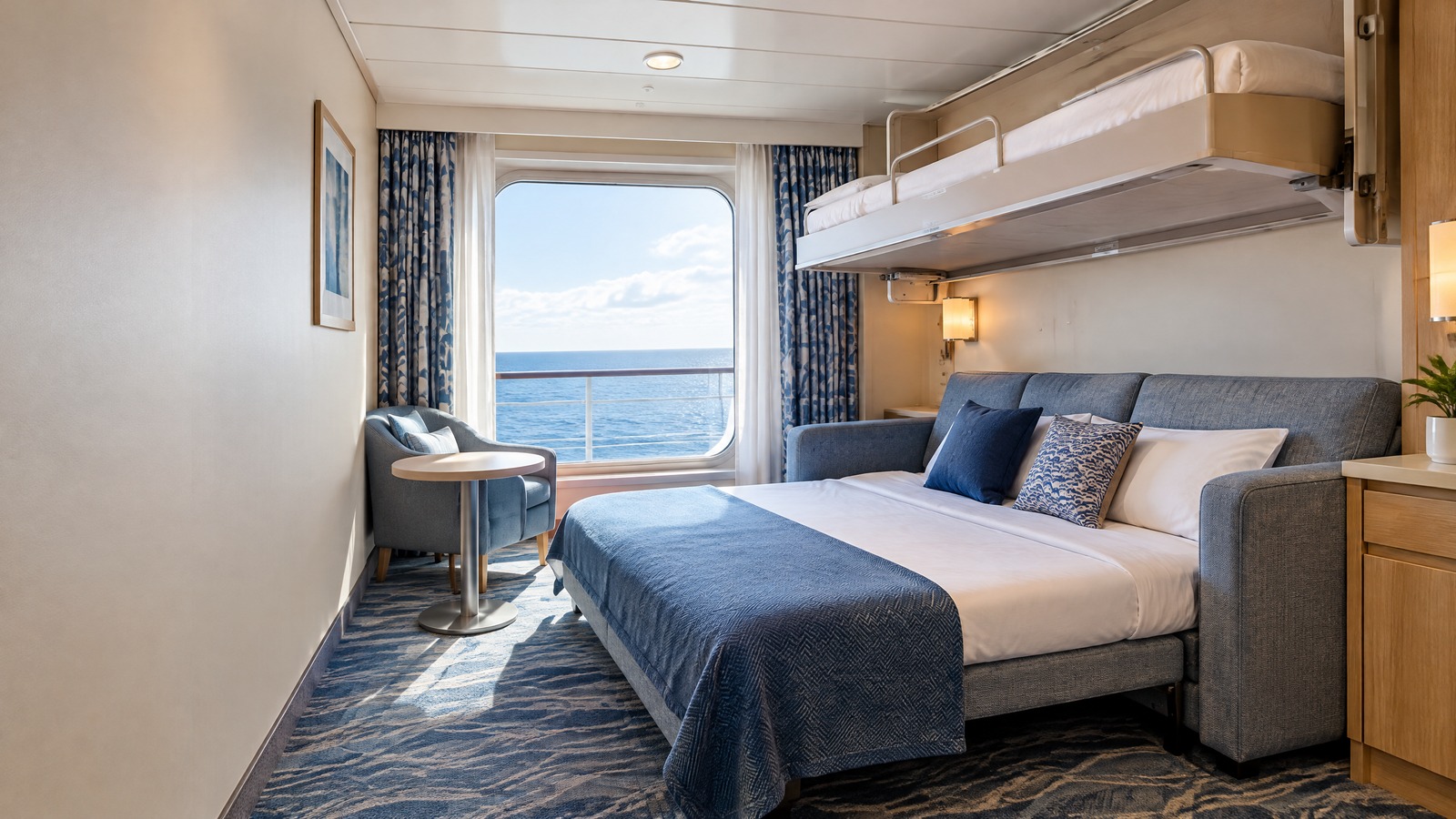
Sleeps four isn’t enough detail. In 2026, UK cruisers should confirm whether a cabin’s extra berths are upper Pullmans or a sofa bed—and who will actually sleep well there. This guide compares space, safety and routines, and shows when two connecting cabins are the smarter choice.
Booking a family or group cabin in 2026 and seeing only “sleeps 3/4/5”? That label won’t tell you who sleeps where. The real-world choice you’ll face is cruise cabin Pullman beds vs sofa beds—and the difference matters. An upper Pullman (also called a pull-down or upper berth) folds from the ceiling or wall, while a sofa bed converts from the couch. Your comfort, floor space, ability to push the lower twins together as a double, and even whether a child can use the top berth all hinge on which one your exact cabin has. This UK-focused guide explains the trade-offs, shows how to read deck plans before you pay, and helps you decide whether one cabin or two connecting cabins suit your party best.
What these bed labels really mean in 2026
On many mainstream lines, a Pullman bed is a space-saving extra berth that folds down from the ceiling or out of the wall in staterooms designed for three or more guests. Royal Caribbean defines it as a bed stored away by day and set up by the attendant at turndown; they say it’s suitable for guests aged 6+ without mobility concerns and list a maximum weight of 300 lb. On P&O Cruises, official guidance says three- and four-berth configurations may include single or double sofa beds, a single sofa bed plus a pull-down bed, or two upper pull-down beds. P&O notes that pull-down beds come from the ceiling or fold into the wall, require a ladder (the ladder is rated to 130 kg) and P&O says upper beds are tested to approximately 300 kg. Cunard states that additional-bed rooms can have a double sofa bed, a single sofa bed and/or an upper bunk-style bed, with stewards making up and putting away sofa beds daily. Marella’s ship pages (for example, Marella Explorer 2) show that three- and four-berth cabins may include a sofa bed or an extra fold-down bed, with details varying by cabin grade. Always verify the precise arrangement for your specific sailing on the line’s official deck plans and cabin notes, as layouts vary by ship and grade.
Why “sleeps four” isn’t enough
Two cabins both labelled “sleeps four” can function completely differently. One might have a double sofa bed at floor level, allowing everyone to stay low but using more evening floor space. Another might have a pull-down upper berth that frees up the lounge area by day but requires safe climbing at night. On P&O, when an upper pull-down is in use, the lower beds must usually remain as twins (with an exception noted for Iona Inside cabins), which is crucial if two adults were counting on a combined double. Conversely, many balcony or mini-suite grades are more likely to use sofa beds. These are general patterns with P&O specifically; exact set-ups still depend on the ship and grade and should be checked on the official site before booking.
How each option changes your floor space and day-to-night flow
A sofa bed typically turns the daytime sitting area into a sleeping surface at night. That can be ideal when nobody wants to climb, but once opened it often occupies the cabin’s central floor—affecting routes to the bathroom and balcony. An upper Pullman preserves that floor during the day because it stows in the ceiling or wall; after turndown you’ll gain a bed without losing all the floor area. However, the ladder and elevated sleeping position introduce climbing considerations. Your best choice depends on how your group uses the cabin after dinner: if late-night balcony trips, bathroom access or quiet reading time matter, consider who will cross which path when the extra bed is set up.
<table><thead><tr><th>Feature</th><th>Upper Pullman (pull-down)</th><th>Sofa bed (convertible)</th></tr></thead><tbody><tr><td>Where it comes from</td><td>Ceiling or wall (varies by line/ship)</td><td>Converts from the cabin sofa</td></tr><tr><td>Daytime floor space</td><td>Maximised: bed is stowed away</td><td>Maximised until evening; once opened, central floor space is reduced</td></tr><tr><td>Climbing involved</td><td>Yes (ladder required on P&O)</td><td>No (floor level)</td></tr><tr><td>Who it can suit</td><td>Guests able to climb; Royal Caribbean advises 6+ without mobility concerns (verify per line)</td><td>Those who prefer floor-level beds; good for mixed ages</td></tr><tr><td>Weight/ladder guidance</td><td>P&O notes ladder 130 kg; upper beds tested to around 300 kg; Royal Caribbean lists 300 lb max (check your line)</td><td>Not typically weight-rated publicly like Pullmans; confirm any limits with your line if relevant</td></tr><tr><td>Lower bed configuration</td><td>P&O: if upper is used, lower beds must remain twins (Iona Inside exception)</td><td>Often compatible with lower twins being pushed together (varies; confirm)</td></tr><tr><td>Evening setup</td><td>Set up by attendant at turndown; stowed by day (per Royal Caribbean)</td><td>Made up and put away daily by stewards (per Cunard)</td></tr><tr><td>Impact on bathroom access</td><td>Typically less obstruction on the floor; ladder adds a climb</td><td>May narrow routes once unfolded; easier for floor-level movement</td></tr><tr><td>Common UK patterns (P&O)</td><td>Inside/Sea view usually upper pull-down (check cabin notes)</td><td>Balcony/Mini-suite usually sofa bed (check cabin notes)</td></tr><tr><td>Privacy/light control</td><td>Upper sleeper may be above eye line; ladder use can disturb others</td><td>Shared space becomes bed; curtains/lamps may affect sleeper</td></tr></tbody></table>
Safety, age and mobility: who should sleep up top?
Upper berths are not for everyone. Royal Caribbean advises Pullman beds are suitable for guests aged 6+ who do not have mobility concerns, with a listed maximum weight of 300 lb. P&O notes that a ladder is required for its pull-down beds, that the ladder is rated to 130 kg, and that upper beds are tested to about 300 kg. Those official lines underline the core point: anyone using an upper berth should be confident climbing safely at night. If you are travelling with younger children, anyone who may need the bathroom frequently, or someone with balance issues, a floor-level sofa bed (or connecting cabin with standard beds) can be the safer, calmer choice. Because policies and equipment can change, always check your sailing’s current guidance on the operator’s website before you book.
Couples and the twin-bed rule when Pullmans are used
On P&O, the lower beds must remain as twins whenever an upper pull-down bed is in use. P&O also notes an exception for Iona Inside cabins. This can be decisive for couples who were planning to push the twins together as a double. Balcony and mini-suite grades on P&O are usually configured with sofa beds rather than upper pull-downs, which can make it easier to have the lower beds joined. These are P&O-specific patterns and still need verifying against your exact cabin’s notes. If your heart is set on a double at floor level and your party also needs an extra berth, inspect the deck plan carefully or consider two connecting cabins.
Families of three, four and five: what’s realistic in one cabin?
For a family of three, either a Pullman or a sofa bed can work well if the third traveller is suited to the berth type. For a family of four, you may find either a double sofa bed or a combination of a sofa bed plus an upper Pullman (P&O cites Iona and Arvia as having a sofa bed with one upper pull-down over it in some grades), or two upper pull-downs in certain grades. Selected staterooms on P&O’s Britannia, Arvia and Iona can accommodate up to five guests, while Cunard notes families of up to four can be accommodated and also highlights adjoining staterooms for more space. Marella’s ship pages show that three- and four-berth cabins may use sofa beds and/or fold-down beds, depending on grade. The key is to check your precise cabin code on the official deck plan: do not rely on a general “family cabin” label to guarantee the mix of berths you want.
Operator examples to guide your search (2026)
- P&O Cruises: Inside/Sea view are usually upper pull-down; Balcony/Mini-suite are usually sofa beds. Iona and Arvia feature layouts where a sofa bed has one upper pull-down above it in some categories. When upper pull-downs are used, lower beds must remain twins (Iona Inside exception). Standard cabins/suites typically sleep up to four; selected Britannia, Arvia and Iona cabins sleep up to five. Always confirm via the cabin notes and deck plan.
- Royal Caribbean: Defines Pullman beds as folding from the wall/ceiling, set up at turndown, for guests aged 6+ without mobility concerns; lists a 300 lb max. Pullmans appear only in some staterooms designed for three or more guests. Bed arrangement requests apply to main beds only and are subject to availability.
- Marella (e.g., Explorer 2): Three-/four-berths may feature a sofa bed or an extra fold-down bed; different grades can have fixed doubles, twin-to-queen beds, double sofa beds or fold-down beds. Check deck and cabin details on the specific ship page.
- Cunard: Additional-bed rooms can include a double sofa bed, a single sofa bed and/or an upper bunk-style bed; stewards make up and put away sofa beds daily; adjoining staterooms are available for more space or parties over four, subject to child-accommodation rules.
These facts come from the operators’ own 2026 guidance pages linked in Sources and verification.
Daytime stowage and turndown: what actually happens
With Pullman beds, Royal Caribbean notes that the bed is stored during the day and is set up by your attendant at turndown, which means the cabin functions as a lounge until evening. With sofa beds, Cunard explains that stewards make up and put away the sofa bed daily—so you’ll regain the seating area in the morning. This difference often decides how “livable” the room feels if you plan daytime naps or quiet reading indoors. If your party keeps staggered schedules, a Pullman may allow the early risers to use the sofa area while a night owl continues sleeping up top. If the Pullman’s ladder or height is a concern, a sofa bed may be easier, accepting that it will occupy space at night.
Night-time movement and noise: who disturbs whom?
Think through bathroom runs and balcony visits after lights-out. With a sofa bed opened, the direct route to the bathroom may involve stepping past a sleeper at floor level. With a Pullman, the route on the floor may be clearer, but the upper sleeper climbs up and down. Families with light sleepers might prefer to assign the upper berth to the heaviest sleeper, or book connecting cabins so adults can keep their routine without tiptoeing through a shared space.
Taller teens and adults: length, climbing and comfort considerations
Many UK readers ask whether a tall teen or adult will be comfortable on a Pullman or sofa bed. There is no universal answer because dimensions, mattresses and designs vary by ship and grade, and lines don’t always publish them. Treat a Pullman as a practical extra berth suited to someone who’s content with a simpler mattress and can climb confidently. Treat a sofa bed as convenient but potentially firmer or differently cushioned than a main bed. If two tall teens are sharing and comfort matters, compare one large cabin against two connecting cabins with standard beds. Verify your chosen cabin’s current specifications with the operator before paying a deposit.
When two connecting cabins are the better buy
Two connecting (or adjoining) cabins can solve several problems at once: more standard beds at floor level, two bathrooms, separate sleep schedules and genuine evening privacy. Cunard explicitly mentions adjoining staterooms as an option for families needing more space or parties over four, and P&O notes that families of six or more will need two cabins, with younger children potentially requiring interconnecting accommodation. While the fare comparison changes by date and grade, UK travellers often find that two modestly priced cabins rival the cost of one larger grade—especially if you were considering a suite mainly to gain sleeping capacity. Compare total square footage and bathrooms along with the berth types before you decide. For a deep dive into the logistics, read our Connecting cruise cabins family guide.
<table><thead><tr><th>Traveller type</th><th>One cabin with Pullman/sofa</th><th>Two connecting cabins</th></tr></thead><tbody><tr><td>Parents + 1 child (age 6+)</td><td>Often fine if child suits Pullman or sofa</td><td>Extra privacy; usually not essential</td></tr><tr><td>Parents + 2 kids (mixed ages)</td><td>Works if berth types match each child; check twin-bed rule</td><td>Two bathrooms and separate schedules can be worth it</td></tr><tr><td>Two adults + tall teen</td><td>Feasible; verify teen’s berth comfort and climbing</td><td>Standard beds for everyone; better sleep quality</td></tr><tr><td>Adults with mobility concerns</td><td>Prefer sofa bed or main beds; avoid upper Pullman</td><td>Gives all guests floor-level beds</td></tr><tr><td>Light sleepers / different bedtimes</td><td>Expect some disturbance in a single room</td><td>Door between rooms lets routines diverge</td></tr><tr><td>Party of five</td><td>Possible only in select cabins on certain ships (e.g., some P&O cabins)</td><td>Often simpler to secure and more spacious</td></tr></tbody></table>
Five-step pre-booking check to avoid surprises
Use this order every time: identify ship and grade; read the deck-plan legend; confirm the extra berth type(s); check any age/mobility/weight rules and lower-bed configuration notes; and finally compare one cabin against two connecting cabins on total space, bathrooms and sleep quality, not only the fare. If you are new to cabin selection, our starter guide [How to choose the right cruise cabin] and comparisons like Inside vs Oceanview or Balcony vs Suite value can help frame the trade-offs.
- Identify your exact ship, sailing and cabin grade. Names repeat across fleets; only the deck plan for your ship counts.
- Read the deck-plan legend and cabin notes. Look for symbols for “upper berth/pull-down” and “sofa bed/double sofa bed,” and any notes about lower-bed restrictions.
- Confirm whether your cabin has a sofa bed, an upper Pullman, or both. On some ships, only certain sides of a corridor, or certain decks, carry upper berths.
- Check suitability rules and limits: age/mobility guidance (e.g., Royal Caribbean’s 6+ without mobility concerns for Pullmans), any listed weight limits (e.g., Royal Caribbean’s 300 lb; P&O’s ladder 130 kg and upper bed testing to roughly 300 kg), and P&O’s note that upper berths keep the lower beds as twins (exception for Iona Inside).
- Compare one cabin to two connecting cabins: total beds at floor level, bathrooms, morning/evening routines, and the fare difference on your dates. If sleep quality, safety or space are priorities, connecting cabins can justify a small premium.
Questions to ask before paying the deposit
- Does this exact cabin (code and deck) have a sofa bed, an upper Pullman, or both?
(Confirm on the line’s site.)
- On P&O, will using the upper Pullman force the lower twins to stay apart in this grade (and is my cabin one of the exceptions, e.g., Iona Inside)?
- If it’s a sofa bed, is it a single or a double in this cabin category?
- Who in our party is realistically suited to each berth type, given height, mobility and night-time habits?
- If two connecting cabins are available, what’s the total space and second bathroom worth to us on this itinerary?
- Can we choose the main-bed arrangement (twin vs queen/king equivalent) in this cabin? (Royal Caribbean allows requests on main beds in many categories, subject to availability.)
- Where can I see the official deck plan and legend for my ship today?
Special cases: toddlers, accessibility and separate routines
If you’re travelling with toddlers or anyone who may be unsafe climbing, plan on floor-level sleep. Royal Caribbean’s Pullman guidance (6+ and without mobility concerns) is a useful signal even if you’re sailing a different line; still, confirm your operator’s rules for your exact cabin. For guests with mobility needs, two connecting cabins can deliver more floor-level beds and an accessible bathroom layout. Read our Accessible cruise cabin guide for considerations and work directly with the operator’s accessibility team. Families with little ones may also value door-closed naps and earlier bedtimes in a second cabin; our Cruise with a toddler packing list (UK) has practical sleep aids to help.
Practical packing to make either bed type work
- Soft nightlight or dimmable torch so upper-berth climbers can see safely without waking everyone.
- Eye masks and light-blocking tape for power LEDs near the sofa area.
- Compact white-noise app or small fan to buffer bathroom trips or balcony door sounds.
- Rubber-soled slippers for safe ladder steps and late-night bathroom visits.
- A fold-flat organiser to keep pyjamas and toiletries accessible when the sofa converts to a bed each night.
These low-cost items help whichever berth you choose and reduce arguments about lights, noise and storage.
How to read deck-plan symbols for extra berths
Open the line’s official deck plan for your ship, then: 1) find your category code; 2) check the legend for symbols like ▲ or star icons indicating an upper berth/pull-down, and sofa bed icons or labels for single/double sofas; 3) read any footnotes about twin-to-double conversion or exceptions. P&O’s cabin guidance specifically instructs checking cabin notes and deck plans for exact configurations, which is good practice on any line. If your chosen category mixes layouts, consider choosing a specific cabin number rather than a “guarantee” allocation if your operator allows it.
<table><thead><tr><th>Person/scenario</th><th>Editorial steer</th><th>Why</th></tr></thead><tbody><tr><td>Child aged 6–10, confident climber</td><td>Upper Pullman can work (verify line rules)</td><td>Frees floor for play by day; child likely ok with simple mattress</td></tr><tr><td>Toddler or anyone who may wake at night</td><td>Sofa bed or standard bed at floor level</td><td>No climbing; easier bathroom access and supervision</td></tr><tr><td>Couple who want a joined double</td><td>Prefer sofa-bed layouts or two cabins</td><td>P&O notes lower beds must stay twins when upper is used (Iona Inside exception)</td></tr><tr><td>Tall teen/large adult as extra guest</td><td>Case-by-case; consider two cabins</td><td>Comfort varies by ship; avoid assumptions about length/firmness</td></tr><tr><td>Guest with mobility concerns</td><td>Avoid upper Pullman</td><td>Royal Caribbean limits Pullmans to those without mobility concerns</td></tr><tr><td>Light sleepers/different bedtimes</td><td>Two connecting cabins if budget allows</td><td>Reduces disturbance and gives a second bathroom</td></tr></tbody></table>
Line-by-line planning prompts for UK cruisers in 2026
- P&O Cruises: Start with the question, “Is this grade usually sofa bed or upper pull-down?” P&O’s guidance says Inside/Sea view are usually upper pull-down; Balcony/Mini-suite are usually sofa beds. If an upper is present, note the twin-bed rule and the Iona Inside exception. For larger families, verify whether your exact Britannia, Arvia or Iona cabin is one of the selected “sleeps five.”
- Royal Caribbean: Confirm whether the stateroom even offers a Pullman and check the 6+ and mobility guidance plus the 300 lb max. Remember: main-bed arrangement requests don’t change the presence of a Pullman or sofa.
- Marella: Use the ship’s cabin page (e.g., Explorer 2) to verify whether your three-/four-berth has a sofa bed, double sofa bed or a fold-down bed. Different grades can vary.
- Cunard: If you prefer floor-level solutions, short-list cabins with double or single sofa beds and note that stewards put them away daily. Consider adjoining staterooms if you need more space or have a party over four (subject to Cunard’s rules).
Verdict for 2026: choose the berth that fits the person
There is no universal winner between Pullman beds and sofa beds. A Pullman preserves floor space and can be ideal for a capable climber, while a sofa bed keeps everyone at floor level at the cost of evening space. The decider is your exact cabin’s layout and your travellers’ ages, mobility, size and routines. Follow the five-step check, verify the configuration on the operator’s site, and if in doubt, compare against two connecting cabins. You’ll trade a little research time now for a lot of sleep quality on board.
Sources and verification
- P&O Cruises — What does a three or four bed cabin look like? (configurations; pull-down from ceiling/wall; ladder required; ladder 130 kg; upper beds tested to close to 300 kg; lower-bed restriction and Iona Inside exception; check cabin notes/deck plans): https://www.pocruises.com/help-hub/centre/life-on-board/cabins/three-or-four-bed-cabin
- P&O Cruises — Which cabin is right for me? (grade patterns: Inside/Sea view usually upper pull-down; Balcony/Mini-suite usually sofa beds; Iona/Arvia sofa bed with one upper pull-down; lower beds must remain twins with uppers; capacity guidance incl. selected five-berths): https://www.pocruises.com/help-hub/centre/booking-a-cruise/booking-a-cabin/which-cabin-is-right-for-me
- Royal Caribbean — What is a Pullman bed? (definition; age/mobility 6+; 300 lb max; turndown setup; available only in some staterooms for 3+): https://www.royalcaribbean.com/faq/questions/what-is-a-pullman-bed
- Royal Caribbean — Can I choose my bed arrangement? (main-bed arrangement requests subject to availability; does not promise extra-berth type): https://www.royalcaribbean.com/faq/questions/choose-bed-arrangement
- Marella/TUI — Marella Explorer 2 cabin details (examples of sofa bed or fold-down bed in 3-/4-berths; grade variations; consult deck/cabin details): https://www.tui.co.uk/cruise/ships/marella-explorer-2/cabins/
- Cunard — Family accommodations with Cunard (double/single sofa beds and/or upper bunk-style beds; stewards make up and put away sofa beds daily; adjoining staterooms as an option for more space or parties over four): https://www.cunard.com/en-us/cunard-stories/family-accommodation
Policies and configurations can change. Always verify your exact cabin’s notes and the current deck plan on the operator’s website before booking.
Frequently Asked Questions
What is a Pullman bed on a cruise ship?
It’s a space-saving extra berth that folds out from the wall or ceiling in some staterooms designed for three or more guests. Royal Caribbean states Pullmans are stored by day and set up by the attendant at turndown. P&O adds that pull-downs can come from the ceiling or fold into the wall and require a ladder. Always confirm availability in your specific cabin’s notes.
Are Pullman beds safe for children?
Royal Caribbean advises Pullman beds are suitable for guests aged 6+ without mobility concerns and lists a 300 lb maximum. P&O notes the ladder is rated to 130 kg and says upper beds are tested to approximately 300 kg. Because guidance can vary by line and ship, check your sailing’s current rules before booking and assign berths accordingly.
Do cruise sofa beds become a double bed?
Sometimes. Cunard’s family guidance mentions double sofa beds and single sofa beds. Other lines may use different designs across ships and grades. Do not assume a double unless the cabin notes say so; confirm whether your specific cabin’s sofa converts to a single or double.
Can we push the twin beds together if a Pullman is used?
On P&O, when an upper pull-down is in use the lower beds must remain as twins, with an exception noted for Iona Inside cabins. This can affect couples who prefer a joined double. Check your exact cabin’s notes for confirmation before booking.
Will a tall teen or adult fit comfortably on a Pullman or sofa bed?
There’s no universal answer because dimensions and mattresses vary by ship and grade. Treat a Pullman as a practical extra berth for someone comfortable climbing. For sofa beds, comfort can differ from the main beds. If height or firmness is critical, consider two connecting cabins with standard beds and verify details with the operator.
Can I request a sofa bed instead of a Pullman when booking?
The extra-berth type is determined by the cabin’s design and grade. Royal Caribbean allows requests to configure the main beds (twin vs king equivalent) in many categories, subject to availability, but that doesn’t change whether the extra bed is a Pullman or sofa. Choose a cabin grade and number that already has the berth type you want.
How are these beds made up and put away each day?
Royal Caribbean notes Pullman beds are stored during the day and set up at turndown. Cunard states that stewards make up and put away sofa beds daily. Many lines follow similar routines, but confirm with your operator and expect variations by ship.
Are there weight limits for Pullman beds?
Royal Caribbean lists a 300 lb maximum for Pullman beds. P&O says its ladders are rated to 130 kg and upper beds are tested to approximately 300 kg. If weight limits are relevant for your party, verify your sailing’s latest guidance with the line before booking.
When should we book connecting cabins instead of one family cabin?
Consider connecting cabins if anyone can’t safely use an upper berth, if adults want a joined double while also needing an extra bed, if you value two bathrooms and separate routines, or if your party size exceeds the listed capacity. Cunard highlights adjoining staterooms for more space or parties over four, and P&O notes larger families may need two cabins. Compare total space, bathrooms and sleep quality as well as fare.
Related articles
- P&O Iona cabins — best deck 2026 guide
- How to choose the right cruise cabin in 2026
- P&O Britannia Cabin Guide 2026: Choose the Right Room
- Accessible Cruise Cabin Guide for UK Travellers 2026
- Connecting cruise cabins for families: the UK guide
- Inside vs oceanview cruise cabins UK: which to book?
- Balcony Cabin vs Suite: Cruise Value for UK Travellers