Can You Take a CPAP Machine on a Cruise? UK Checklist for 2026
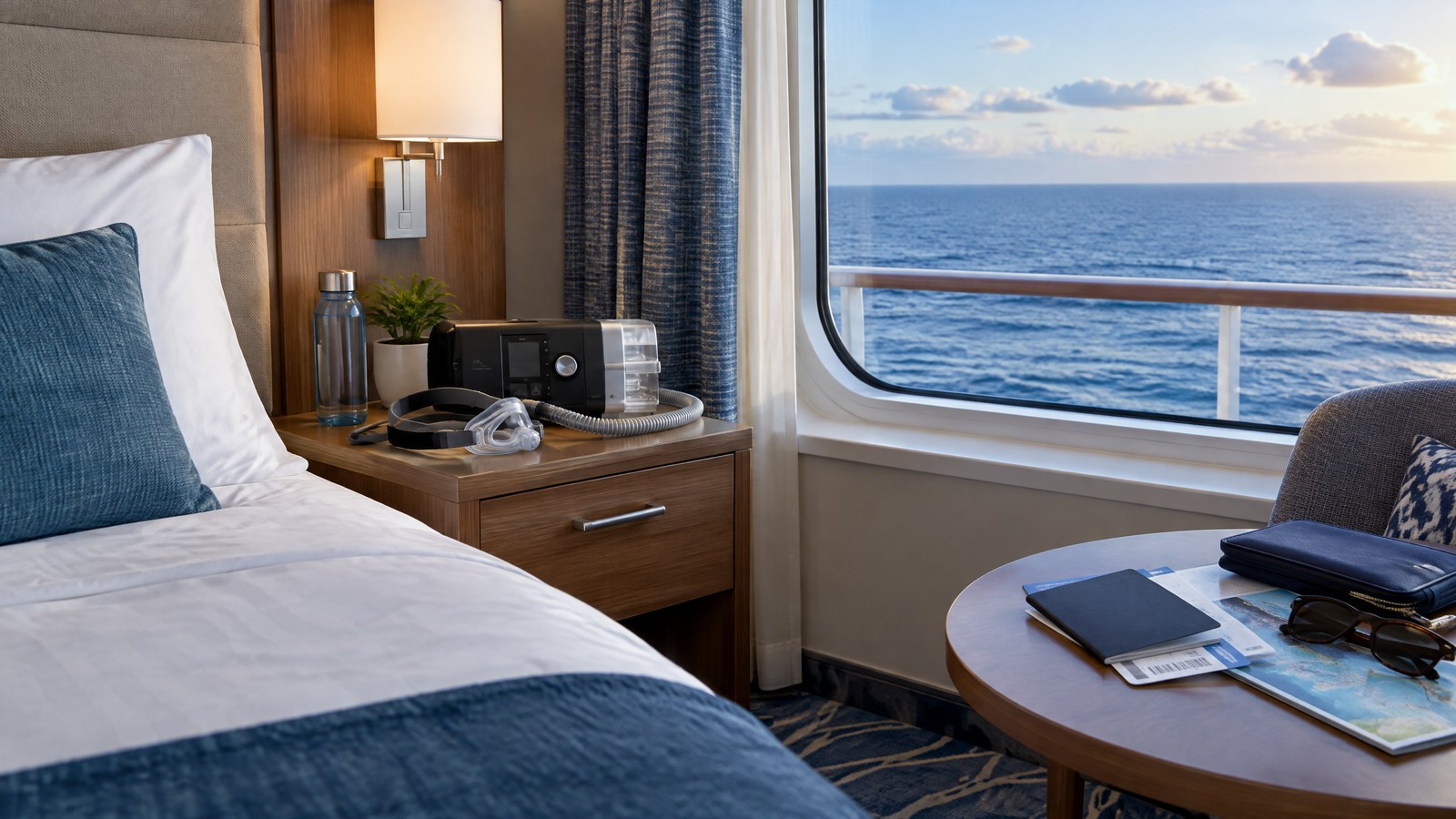
Yes, you can usually take a CPAP machine on a cruise — but don’t assume a home setup will be replicated at sea. This 2026 UK guide explains how to notify the cruise line, check cabin power and extension-lead rules, plan humidifier water, pack for embarkation, and handle a fly-cruise and insurance, with links to official operator guidance.
Can you take a CPAP machine on a cruise? For most UK travellers in 2026, the practical answer is yes — provided you follow your chosen cruise line’s process and confirm the electrical and packing details before you sail. Policies vary by operator, ship and itinerary, so do not treat CPAP as ordinary luggage or assume your bedroom setup at home will be replicated in a stateroom. This guide explains what to tell the line, how to check cabin power safely, when a CPAP extension lead on a cruise is permitted, how to think about distilled water for CPAP on a cruise, and what changes if you are flying to the port. It also covers insurance and when to speak to your clinician. Throughout, we signpost official guidance and point you to related UK-focused planning articles on MyCruiseAdvisor.co.uk.
The short answer: yes, but check your cruise line first
Cruise lines commonly accommodate CPAP users, but acceptance and the practical arrangements are line-specific. For example, Cunard’s published 2026 guidance for medical and mobility equipment asks guests to notify the line of a CPAP, carry it on where possible, be prepared for an electrical inspection before sailing, and confirm that the machine is compatible with ship’s power (Cunard notes 110/220V and 60Hz on board). Princess Cruises’ pre‑cruise FAQs say CPAP, BiPAP and APAP machines may be used on board and should be carried in hand luggage, with passengers providing their own supplies. P&O Cruises advises travellers using CPAP to confirm fitness to travel with their primary healthcare provider and to have insurance that covers all pre‑existing conditions. These are examples, not universal rules. Always verify the current policy on the operator’s official site before booking because procedures, forms and deadlines can change during 2026.
Tell the cruise line what you need — and do it early
Early, accurate notification gets the right arrangements in place. Lines generally ask you to complete an accessibility or medical-needs form after booking and before a stated deadline. As a concrete example for 2026, Cunard asks guests to notify medical or mobility equipment needs as soon as possible after booking via its On Board Needs Questionnaire, and no later than two weeks before sailing; it also asks guests to advise the line if they are bringing a CPAP so electrical compatibility can be checked. Treat that as a Cunard-specific rule rather than a fleet-wide standard. Whatever line you choose — P&O, Cunard, Marella, Princess or others — tell it exactly what you will bring and what you will need well in advance of final payment where possible.
What to include in the request
To reduce back-and-forth, include the essentials the first time you contact the line:
- Your booking reference, ship and sailing date.
- Device make and model exactly as printed on the label.
- Electrical input details from the device label/manual (voltage range and frequency in Hz).
- Whether you use a humidifier and if so, whether you need distilled water.
- Whether you believe you will need an extension lead and the reason (for example, mask hose reach versus socket location).
- Any accessories you plan to bring (mask, hose, filters, humidifier chamber) so the team understands this is routine CPAP rather than oxygen or ventilator support, which are separate categories.
Ask the line to confirm: the correct notification process for your sailing; whether any electrical inspection will occur at embarkation; if a personal extension lead is permitted for CPAP; the ship’s power supply specification; and the line’s position on distilled or alternative water for humidifiers.
Get practical arrangements confirmed in writing
Keep a written record of the cruise line’s replies and take copies with you to the port. If your machine, accessories or itinerary change, update the line in writing. Submitting a form is not the same as receiving approval: wait for the operator’s confirmation and follow any instructions it gives you for embarkation day.
Cabin power and extension leads: the checks that matter
Your CPAP machine is designed for a particular range of voltage and frequency. Cruise ships commonly provide 110V and/or 220V at 60Hz, which is different to the UK domestic 230V 50Hz environment. As of 2026, Cunard publishes this exact point and tells guests to seek advice from their CPAP manufacturer or supplier about 60Hz compatibility. Some cabins have a mix of socket types and locations; never assume the bedside will have the outlet you want. If you require an extension, ask the line in advance rather than packing a generic household power strip.
Voltage, frequency and adaptors explained simply
- Voltage: Many modern devices accept a range (for example, 100–240V), but do not guess. Read your CPAP’s power-brick label or manual and confirm with the manufacturer or supplier if you are unsure.
- Frequency (Hz): This matters. Ships often run at 60Hz; the UK is 50Hz. As Cunard notes, you must check with the device maker or supplier whether your specific CPAP can be used safely at 60Hz without damage or performance issues.
- Plug shape vs. power spec: A travel adaptor only changes the plug shape; it does not convert voltage or frequency. Ensure the device itself is compatible.
- Socket locations: Cruise cabins vary. If you need to place the machine a certain distance from a socket, discuss this with the line in advance and ask whether a personal medical extension lead is permitted for CPAP use on your sailing.
CPAP extension lead on a cruise: what “allowed” tends to mean
Rules differ by operator. For 2026, Cunard explicitly allows a personal extension lead only for essential medical equipment such as CPAP or nebuliser machines, advises it should be at least three metres long, and states that surge‑protected extension leads are not accepted. Treat that as a Cunard example, not a universal standard. Other lines may have different specifications or may supply an approved lead. Always follow the written rule given by your booked operator and do not bring unapproved power strips or surge protectors.
Humidifier water and CPAP supplies
If your CPAP uses a humidifier, water planning is separate from electricity. In 2026, Cunard’s published guidance says it cannot provide distilled water onboard and recommends that guests bring their own supplies or discuss a suitable alternative with their respiratory team or CPAP manufacturer. Do not assume that ship tap water or bottled water is acceptable for your device. Follow the device maker’s recommendation and ask your cruise line what it will allow you to bring aboard. If liquid quantities are restricted during embarkation or airline security, ask the operator and (for fly‑cruises) the airline how to handle this practically.
Distilled water for CPAP on a cruise: what to ask
- Does your CPAP’s manufacturer require distilled water, or is demineralised/filtered water acceptable as an alternative?
- Will your chosen cruise line supply any water type, sell it onboard, or allow you to bring sealed containers? Cunard says it cannot provide distilled water.
- If you are flying, what are the airline’s rules on carrying water for medical devices, and how should it be packed? Treat this as an airline-specific question and seek the carrier’s written guidance.
- How many nights at sea and travel days do you need to cover? Build in a margin for delays.
How to pack and carry a CPAP on embarkation day
Carry the machine and its essential parts with you to the ship where possible. In 2026 guidance, both Cunard and Princess advise carrying medical devices in hand luggage. Cunard also notes its Electrical Officer may inspect or test equipment before the ship sails. Checked bags can be delayed or handled out of your sight; for an essential therapy device, carry‑on is the safer default, subject to terminal security rules. For a full embarkation-day essentials overview, see our UK checklist: Cruise Embarkation Day Bag Checklist at cruise-embarkation-day-bag-checklist. For broader packing context, refer to ultimate-cruise-packing-list and cruise-packing-list-essentials.
- CPAP machine body and power supply/lead.
- Mask, headgear, and hose.
- Humidifier chamber (if used) and approved water plan per manufacturer guidance.
- Spare cushions/seals/filters as recommended by your supplier.
- Travel adaptor(s) appropriate to the ship, not a surge‑protected strip.
- A permitted medical extension lead if your line allows personal leads for CPAP.
- Written confirmation from the cruise line of your declared needs and any instructions.
- A copy of the device label photo and any manufacturer statement about 60Hz compatibility.
- If flying, airline confirmation about carriage and any in‑flight use rules.
Flying to your cruise? Treat the flight as a separate check
A fly‑cruise adds another layer. The NHS (University Hospitals of North Midlands NHS Trust) advises CPAP users to carry the device as hand luggage when flying, to contact the airline in advance as an extra carry‑on allowance may be possible, and notes that arrangements for in‑flight use vary by airline and aircraft. Cunard’s medical equipment page likewise cautions that some airlines restrict device models and that not all aircraft provide suitable power; it recommends carrying enough battery capacity for the entire journey, including connections and unexpected delays. Do not assume an airline will allow in‑flight use or provide power — get the airline’s written guidance for your exact flights.
- Book flights with sufficient connection time to manage medical equipment calmly.
- Contact the airline immediately after booking to ask about CPAP carriage, any extra medical-bag allowance, and in‑flight use rules for your aircraft type.
- Pack the device in hand luggage with documentation. Do not check the machine.
- If you may need to use CPAP during long‑haul, ask the airline whether use is permitted, whether power is available at your seat, and what battery evidence (if any) is required.
- Carry enough battery capacity and supplies for the full journey, including transit and delay, if your clinician advises a battery is appropriate for you.
- At the airport and cruise terminal, declare your medical equipment calmly if asked and follow security instructions.
- Reconfirm arrangements with the ship’s guest services team once aboard, especially if the machine was inspected at the terminal.
Speak to your clinician and check insurance
This article does not assess your personal fitness to travel or modify therapy. In 2026, P&O Cruises advises guests travelling with CPAP to confirm fitness to travel on their chosen itinerary with their primary healthcare provider and to ensure they carry full travel insurance covering all pre‑existing medical conditions. Cunard also recommends discussing plans with your GP or consultant and holding adequate insurance. For practical UK pointers on policy selection and declaring conditions, see our guide: cruise-travel-insurance-guide.
CPAP cruise checklist: seven UK‑ready steps
- Tell the cruise line at booking or as soon as possible and follow its stated medical/accessibility process by its own deadline.
- Provide the exact CPAP model, voltage and frequency details, and whether you use a humidifier.
- Confirm in writing whether a CPAP extension lead is permitted and what type is acceptable on your sailing.
- Ask about water: whether distilled water is provided, sold, or may be brought on; follow your device maker’s recommendation.
- Pack the machine and essentials in your embarkation-day bag; do not rely on checked luggage.
- Keep the line’s confirmation and cooperate with any electrical inspection at the terminal.
- If flying, repeat the checks with your airline; do not assume power or in‑flight permission.
<table><thead><tr><th>Traveller type</th><th>Main checks to prioritise</th><th>Who to contact first</th><th>Editorial recommendation (2026)</th></tr></thead><tbody><tr><td>UK round‑trip cruise, no flights</td><td>Line’s CPAP notification, cabin power (60Hz), extension‑lead permission, water policy</td><td>Cruise line accessibility/medical team</td><td>Send a written request with your CPAP model and power spec; carry device on; confirm any lead/water rules in writing before final payment.</td></tr><tr><td>Fly‑cruise to the Med/Caribbean</td><td>All of the above plus airline carriage and any in‑flight use; battery planning for delays</td><td>Airline and cruise line (both, in writing)</td><td>Treat flight and cruise as separate approvals; do not rely on aircraft power; keep airline confirmation with your boarding pass.</td></tr><tr><td>First‑time CPAP cruiser</td><td>Manufacturer confirmation about 60Hz; clinician advice on travel and humidifier needs</td><td>CPAP supplier/manufacturer, then cruise line</td><td>Get device‑specific compatibility in writing before you buy adaptors or batteries; share that info with the line.</td></tr><tr><td>Traveller who needs a long hose reach</td><td>Socket locations, permitted medical extension lead, cabin layout suitability</td><td>Cruise line accessibility team</td><td>Ask the line about approved leads for CPAP and consider an accessible cabin after reading our room planning guide.</td></tr><tr><td>Budget‑conscious traveller</td><td>What the line already provides vs. what you must bring; airline allowances</td><td>Cruise line and airline</td><td>Avoid buying unapproved power strips or surplus accessories; bring only line‑permitted items and confirm allowances in writing.</td></tr><tr><td>Partner sharing a compact cabin</td><td>Machine placement, noise considerations, safe cable routing</td><td>Cruise line (cabin power questions)</td><td>Request advice on safe placement and lead routing; board early to set up before the first night.</td></tr></tbody></table>
What to expect at the terminal and on board
On embarkation day, keep your CPAP and confirmation letters in your carry‑on. Some operators — for example, Cunard in 2026 — may ask their Electrical Officer to inspect or test medical equipment before sailing. If you have declared a CPAP extension lead with permission to use it, keep it accessible for inspection. Once in your cabin, identify the safest approved socket arrangement before bedtime. If anything differs from what you expected, speak to Guest Services right away rather than improvising with an unapproved adaptor or lead.
CPAP and cabin choice: practical planning
If you rely on a specific machine position or hose reach, cabin selection matters. Consider discussing room layout, socket locations and lead permissions with the line’s accessibility team before you commit. For broader room‑planning advice — including when an accessible stateroom may be the better fit — see our UK guide: accessible-cruise-cabin-guide. Be clear with the line that you use CPAP (not oxygen) so you are directed to the correct process.
Editor’s assessment: who cruises well with CPAP?
Editorial view (not medical advice): travellers who communicate early, carry their device on, and verify power and water arrangements in writing tend to cruise smoothly with CPAP. UK round‑trip itineraries without flights reduce complexity; fly‑cruises add an airline step that needs the same discipline. If your device is clearly marked for 100–240V and 50/60Hz, your pre‑sailing checks are simpler — but you must still confirm extension‑lead and water rules with the operator. If in any doubt about fitness to travel, follow P&O’s 2026 advice and speak with your primary healthcare provider before you book.
Sources and verification
This article is anchored to operator and NHS sources current in 2026. Always check for updates on the official pages before you book or sail:
- Cunard — Medical and mobility equipment (CPAP notification, hand luggage, electrical compatibility and inspection, extension leads and water): https://www.cunard.com/en-us/accessibility/medical-and-mobility-equipment
- P&O Cruises — Enhanced health and well‑being measures (fitness to travel and insurance for pre‑existing conditions): https://www.pocruises.com/cruise-with-confidence/enhanced-health-measures
- University Hospitals of North Midlands NHS Trust — Advice for current CPAP patients (travel by sea and air, contact the company in advance, cabin power supply, hand luggage for flights): https://www.uhnm.nhs.uk/hospitals-and-services/sleep-service/adult-sleep-service/advice-for-current-cpap-patients/
- Princess Cruises — Pre‑cruise FAQs (CPAP/BiPAP/APAP allowed onboard, carry in hand luggage, bring your own supplies): https://www.princess.com/faq/pre-cruise
Related Cruise Advisor health‑planning context: Taking Insulin on a Cruise from the UK at taking-insulin-on-a-cruise-from-uk and Oxygen Concentrators at cruise-with-an-oxygen-concentrator-uk.
For the wider medical-planning picture, see our cruise ship medical facilities guide before travelling.
Frequently Asked Questions
Do I need to tell the cruise line about my CPAP machine?
Yes. Many operators ask for early notification through an accessibility or medical-needs process. In 2026, Cunard specifically instructs guests to advise it if bringing a CPAP and to complete its On Board Needs Questionnaire as soon as possible after booking. The NHS travel guidance also tells CPAP users going by sea to contact the company in advance and ensure an appropriate cabin power supply. Check your chosen line’s exact process and deadline.
Can I bring an extension lead for CPAP on a cruise?
Only if your booked line permits it and only in the form it specifies. As an example, Cunard’s 2026 guidance allows a personal extension lead for essential medical equipment such as CPAP or a nebuliser, recommends at least three metres, and does not accept surge‑protected leads. Treat this as Cunard‑specific; other operators may differ. Get the permission and specification in writing from your line before packing a lead.
Will a cruise ship provide distilled water for my CPAP?
Do not assume so. Cunard’s current 2026 guidance states it cannot provide distilled water. Follow your CPAP manufacturer’s recommendation on water type and ask your chosen line whether you may bring it or source it onboard. If you are flying, obtain separate airline approval for carrying liquids.
Should I put a CPAP machine in checked luggage?
Carry it with you where possible. Both Cunard and Princess advise passengers to carry medical equipment in hand luggage. Checked bags can be delayed or mishandled, and some operators may wish to inspect or test the device before sailing. Keep your line’s confirmation and any documentation accessible at embarkation.
Can I use my CPAP on a fly‑cruise?
Possibly, but treat airline and cruise‑line checks separately. The NHS advises carrying CPAP in hand luggage when flying and contacting the airline in advance, as in‑flight use rules vary and aircraft power is not guaranteed. Cunard also notes some airlines restrict device models and recommends carrying enough battery capacity for the whole journey, including delays. Obtain the airline’s written guidance for your exact flights.
Do I need a doctor’s letter or medical certificate to take CPAP on a cruise?
There is no universal requirement. Some airlines or operators may ask for documentation. NHS guidance indicates that travel and customs letters can be provided for overseas travel if needed. Ask your cruise line and, for fly‑cruises, your airline what they require. Separately, P&O advises CPAP users to confirm fitness to travel with their primary healthcare provider and to hold insurance that covers pre‑existing conditions.
Will my UK plug work in the cabin?
Not necessarily. Ships may provide 110V and/or 220V at 60Hz, and sockets may be different from UK domestic outlets. A travel adaptor only changes the plug shape; it does not change voltage or frequency. Cunard highlights the 60Hz point and tells guests to check with the CPAP manufacturer or supplier that their exact model is compatible. Always verify your device’s label/manual and the ship’s power specification before sailing.
What if my CPAP is not 60Hz‑compatible?
Do not use it on ship power without guidance. Contact your device manufacturer or supplier for alternatives that are safe for your model, and speak to your clinician about your options for travel. Do not improvise with transformers or unapproved accessories. If you cannot obtain clear written confirmation of safe use at 60Hz, reassess the sailing or request alternative arrangements with the operator before you commit.
Are CPAP batteries allowed on cruises and flights?
Policies vary. For flights, follow your airline’s specific rules on battery carriage, capacity limits and documentation. Cunard advises travellers not to rely on aircraft power and to carry enough battery capacity for the whole journey, including delays, if you need to use the device in transit. On ships, check your line’s rules before bringing any battery equipment and always use manufacturer-approved power solutions.
Is a compact travel CPAP better for a cruise than my home unit?
It depends. A smaller device may pack more easily, but your decision should be based on clinical advice and manufacturer guidance about power and water compatibility at sea. Before buying another device, confirm that your existing machine is safe to use at 60Hz and meets your therapeutic needs on holiday. Discuss any change of device with your clinician and supplier, and confirm arrangements with your cruise line in writing.
Related articles
- Ultimate Cruise Packing List 2026: Everything You Need to Bring
- Cruise Travel Insurance Guide: What Does It Cover?
- Cruise Packing List Essentials: What to Bring on a Cruise
- Cruise Embarkation Day Bag Checklist: What to Pack
- Accessible Cruise Cabin Guide for UK Travellers 2026
- Taking insulin on a cruise from the UK: the 2026 guide
- Cruise with an oxygen concentrator UK: what to do