How Many Shoes to Pack for a Cruise: UK Guide
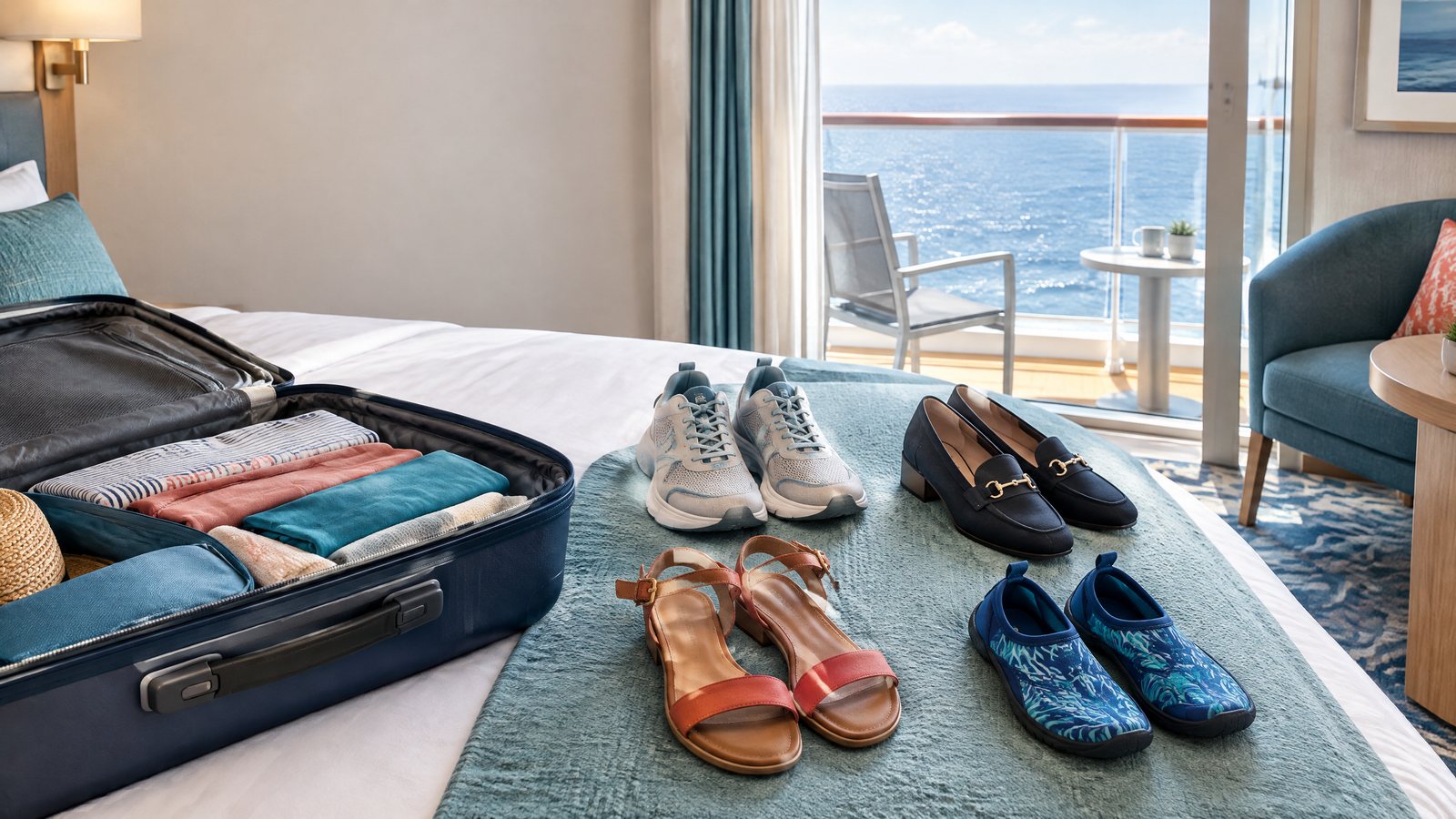
Wondering how many shoes to pack for a cruise? Our UK-focused 2026 guide gives you a practical number, a decision table, and clear advice for P&O, Fred. Olsen and typical itineraries. Start with three functional pairs and add only if your booked activities, climate or personal needs require it.
How many shoes to pack for a cruise? If you’re sailing from the UK or flying to join a ship, shoes can be the bulkiest part of your case—and the hardest to get right. Pack too few and you risk sore feet or being underdressed; pack too many and you waste precious space. This 2026 UK guide gives you a crisp, number-first answer and then helps you adapt it to your ship, excursions and comfort. It draws on current guidance from P&O Cruises and Fred. Olsen Cruise Lines for the roles your shoes need to cover, while keeping the final number flexible so it works for your itinerary and needs. You’ll also find a decision table, traveller-type recommendations, and money-saving tips, along with links to related Cruise Advisor guides for outfits, formal nights and excursions.
Why the number depends on your actual plan
There isn’t a universal shoe limit that fits every cruise line, ship or guest. Operators such as P&O Cruises and Fred. Olsen describe the functions your footwear should cover—walking, evening, and pool/spa—but they do not set a single, fleet-wide maximum number of pairs for every passenger. That’s because the right count depends on your exact trip:
- Your itinerary and activities: Shore days with light city walking are different to hikes or e-bike tours. P&O’s own excursion pages show that specific activities may mandate closed-toe or hiking footwear for safety. If your plans include anything terrain-heavy, that instruction overrides a minimalist plan.
- Dress expectations: P&O explains that evening dress details can vary by itinerary and are confirmed via its daily Horizon and My P&O Cruises information. If you choose to dine in venues with smart-casual or more formal expectations, an evening-appropriate pair becomes useful.
- Pool and deck use: Pool days and spa visits are simpler in flip-flops or sandals. Fred. Olsen notes that flip-flops or sandals are advisable on deck by the pool because decks can become warm and slippery. These aren’t substitutes for walking shoes or activity footwear.
- Personal comfort and mobility: Orthotics, balance, injury management and blister prevention may require specific, familiar footwear even if that means bringing an extra pair. Prioritise safe, known-to-you shoes over a number target.
- Travel to port: If you’re travelling by UK rail, you’ll likely want to keep luggage manageable and properly labelled, as not all operators have dedicated luggage-assistance staff.
In short: use the three-pair baseline to stay compact, then add only if your own plans—and your line’s requirements—justify it.
<table><thead><tr><th>Step</th><th>Ask yourself</th><th>Decision</th></tr></thead><tbody><tr><td>1. Walking baseline</td><td>Will you walk ship decks, terminals or ashore?</td><td>Keep one familiar, comfortable, supportive walking pair. P&O recommends at least one for walking/exercise.</td></tr><tr><td>2. Evening role</td><td>Do your chosen venues call for smart casual or more formal outfits?</td><td>Add one evening-appropriate pair if your walking pair won’t suit. Check line/ship/venue guidance before sailing.</td></tr><tr><td>3. Pool/spa/beach</td><td>Will you use the pool/spa or plan a beach-style day?</td><td>Add flip-flops/sandals for pool/spa. They are not a replacement for activity footwear.</td></tr><tr><td>4. Activity override</td><td>Have you booked hiking, e-biking, or terrain/water-specific activities?</td><td>Follow the exact excursion instruction. If it specifies closed-toe or hiking shoes, add or substitute accordingly.</td></tr><tr><td>5. Conditions & needs</td><td>Cool/wet route, uneven ground, or reliance on orthotics/support?</td><td>Prioritise safety and comfort. Add a specialist pair only if roles can’t safely overlap.</td></tr><tr><td>6. Transit test</td><td>Can you manage your bag to the port/airport?</td><td>Keep the total shoe count practical for your journey and luggage handling.</td></tr></tbody></table>
The three-pair baseline: what each pair must do
Three pairs work on many UK-sailed or fly-cruises because each covers a distinct role most travellers will encounter: walking, evening, and pool/spa. This structure is grounded in operator guidance about functions rather than a fixed pair count. P&O Cruises’ packing advice highlights comfortable, supportive shoes for walking or exercise and to consider evening footwear plus flip-flops or sandals for the pool or spa. Fred. Olsen suggests daytime shoes, comfortable walking shoes for exploring, and flip-flops or sandals for pool areas, with dress shoes for formal nights as an option. That list is descriptive, not prescriptive, and roles can overlap if your outfits allow. Below, we define each pair and how to choose it sensibly.
Pair 1: Comfortable, supportive walking shoes
This is the anchor of your shoe plan. P&O Cruises’ packing list specifically recommends at least one comfortable, supportive pair for walking or exercise. Fred. Olsen strongly recommends comfortable walking shoes for exploring destinations. Think in terms of predictable comfort on ship decks, in terminals, and ashore on city pavements—shoes you already know you can walk in for hours without rubbing. If your itinerary includes tender ports, remember that P&O’s safety guidance separately mentions rubber-soled footwear for tender boats and exploring ashore; check your own operator’s current wording, then choose a pair with grippy soles and a secure fit. If you rely on orthotics or have a history of blisters, bring the exact pair that works with your inserts rather than gambling on a new model.
Pair 2: Evening-appropriate shoes for smart casual or dressier nights
Evening expectations vary by line, ship and venue. P&O describes smart-casual and Black Tie evenings and asks guests to adhere to smart casual in public areas and restaurants, with specifics communicated in the daily Horizon and via My P&O Cruises. That supports the idea of an evening-appropriate pair—something that works with your chosen outfits and the venues you plan to visit. You do not need a dedicated dress shoe if your walking pair already looks smart enough for the occasions you’ve planned and your line’s guidance allows. Conversely, if you enjoy dressier venues or outfits, a separate evening pair helps protect your comfortable walking shoes from scuffs and maintains the look you want. If you’re still weighing outfits, read What to Wear on a Cruise and Cruise Formal Night What to Wear 2026: Your Ultimate Guide to align your footwear with realistic dress codes.
Pair 3: Flip-flops or sandals for pool and spa days
Pool and spa footwear keeps things easy in wet leisure areas and on hot decks. P&O’s packing list mentions flip-flops or sandals for the spa or pool, and Fred. Olsen notes that flip-flops or sandals are advisable by the pool because decks can become warm and slippery. Treat them as role-specific: great for the pool or beach, sometimes for casual ship wandering, but not a substitute for walking or activity shoes. P&O also asks guests to wear shoes away from the pool and says pool wear is not allowed in lounges, indoor bars, restaurants or reception, so you’ll want something more substantial when you leave the pool area. If your itinerary is cool-weather with no pool days planned, you can skip this pair, but many travellers still find lightweight pool slides handy for spa visits or steaming in the thermal suite.
When to take a fourth pair
Add a fourth pair only when your real plans, conditions or needs require it. This is the moment to stop thinking about “numbers” and start thinking about hard requirements. If an excursion page requires closed-toe shoes, or if winter weather demands waterproof footwear, add or substitute accordingly. If you need a spare pair of the same model to support an orthotic or to rotate when wet, prioritise safety and comfort. The right call is the one that avoids injury, slips or being turned away from an activity.
- A booked hike that recommends hiking shoes. P&O’s Ålesund E-bike & Hike page, as a single activity example, recommends appropriate hiking shoes for its hike element. That is not a universal rule, but it shows why activity pages matter.
- A cycling excursion that requires closed-toe shoes. P&O’s Santander by E-Bike experience requires flat, closed-toe shoes. If your booking says this, you need them.
- Water or beach activities needing water-capable shoes. Check your exact excursion page; do not assume pool flip-flops will be acceptable or safe.
- Wet, cold or uneven terrain where your walking pair lacks grip or weather protection. In this case, consider substituting a sturdier pair rather than simply adding a duplicate function.
- Orthotics, balance or medical needs that limit your footwear options. If one supportive pair won’t cover day and evening, add what you need for safe, comfortable movement on board and ashore.
- Tender-heavy itineraries where a grippy rubber-soled pair is advisable for moving between ship and tender (P&O advises rubber-soled footwear for tender boats and exploring ashore; check your own operator).
<table><thead><tr><th>Traveller type</th><th>Recommended count</th><th>Why</th></tr></thead><tbody><tr><td>Typical UK traveller (no formal activities booked)</td><td>3 pairs</td><td>Walking, evening-appropriate, and pool/spa cover the most common ship-and-ashore roles.</td></tr><tr><td>Activity excursion traveller (e-bike, hike, water activity)</td><td>3–4 pairs</td><td>Start with three; add a fourth only if the excursion instruction requires hiking or closed-toe footwear.</td></tr><tr><td>Cool/wet or terrain-heavy itinerary</td><td>3 pairs (with substitution)</td><td>Swap the standard walking shoe for a sturdier/water-resistant option rather than adding a duplicate.</td></tr><tr><td>Rail-to-port traveller</td><td>3 pairs</td><td>Stay compact to manage luggage on trains; label bags and plan for minimal assistance.</td></tr><tr><td>Comfort/mobility/orthotics-first planner</td><td>3–4 pairs</td><td>Prioritise familiar supportive footwear; add a duplicate or specialist pair only if roles cannot safely overlap.</td></tr></tbody></table>
Decks, tendering and going ashore: safety-led choices
Wet, hot or uneven surfaces are part of the cruise experience, especially outdoors. P&O’s safety and security guidance states that outside decks may be wet and hot and advises wearing suitable shoes; it also says rubber-soled footwear should be worn for tender boats and when exploring ashore. Follow your own operator’s safety notes, because instructions can vary by line and change over time. Even if your itinerary looks calm, assume occasional slipperiness on open decks and pick footwear that grips and stays on your foot securely. For tendering days, plan to wear your grippy walking pair rather than pool slides. If you’ve booked an activity, the excursion page takes precedence over generic advice—if it says closed-toe or hiking shoes, that’s the requirement you should plan to meet.
Dinner and dress codes: check before you pack the evening pair
On P&O, evening details (including whether a night is smart-casual or Black Tie) are provided through the daily Horizon and in My P&O Cruises. That’s your signal to keep your evening footwear flexible until you’ve checked your own voyage. If you enjoy dressing up, pack a pair that elevates your outfit without compromising stability on stairs and carpets at sea. If you prefer simplicity, a neat pair of trainers or flats can be sufficient for many casual venues when permitted by your line and venue. For focused dining footwear advice, see What Shoes To Wear To Dinner On A Cruise in 2026 and pair that with What to Wear on a Cruise to ensure your shoe choice suits your evening plans. Always confirm the current guidance for your ship and booking before you sail.
Can you do it with two pairs? The leanest viable plan
Two pairs can work for some travellers, but only when roles safely overlap and no booked activity sets a stricter requirement. The leanest plan is a supportive, smart-looking walking shoe that also passes muster for the venues you’ll visit in the evening, plus pool slides or sandals if you’ll use the pool/spa. If you won’t use the pool and you’re confident your walking pair fits the evening venues you’ve chosen, you could travel with two. The trade-off is resilience: a single walking pair has to do every mile ashore and every evening, so it must be fully broken in and reliable for the whole trip. For many UK travellers, that risk-reward balance still points to the three-pair baseline.
When five pairs makes sense—and when it doesn’t
Five pairs can be justifiable if your cruise plan naturally spans more roles that cannot overlap safely: a formal-dress evening shoe you value for its look; a supportive walking trainer; a waterproof trail shoe for rugged ports; pool sandals; and a closed-toe water shoe for a specific activity. This is role-led, not fashion-led. But if two or more pairs duplicate the same role, you’re likely carrying dead weight. Every extra pair must earn its place by satisfying a confirmed requirement that another pair cannot meet—especially if you’re taking trains or coaches to the port. If you’re wavering, ask: could one pair safely and acceptably do two roles? If yes, you probably don’t need both.
A UK departure note: rail-to-port reality check
If you’re travelling to the port by train, keep your luggage workable. Greater Anglia’s on-board FAQs state that all luggage must be labelled under the National Rail Conditions of Travel and that it does not have dedicated luggage-assistance staff, though teams may help where possible. Take that as a cue to pack a shoe count you can comfortably carry and lift. Label your bags clearly and allow extra time for station changes. For broader luggage planning around UK cruise departures, see our route-focused overview in Cruise luggage allowance from Southampton 2026, and cross-check with your rail operator before travel.
Packing techniques to keep shoes compact
Even with three pairs, strategy matters. Aim to wear the bulkiest pair for embarkation (often your walking shoe) so it doesn’t take space in the case. Pack the evening pair heel-to-toe in a dust bag and fill the toes with socks to protect their shape. Place pool flip-flops or sandals flat against the case wall or inside a packing cube lid. Wipe soles and bag them so clothes stay clean. Keep the heaviest shoes low in the case to stabilise your luggage. If you’re flying, remember that airline allowances and policies vary and can change; check your ticket details before you travel rather than relying on old rules.
- Wear-test your walking pair for at least an hour at home—no rubs, no hotspots.
- Confirm your evening venues and check your line’s current dress guidance.
- Open each booked excursion page and note any footwear requirements.
- If tender ports are listed, plan a grippy, secure pair for those days.
- Adjust for climate: swap to a sturdier or water-resistant walking pair if conditions warrant it.
- Fit orthotics and test with cruise-length walking time.
- Clean and re-lace shoes; check tread and insoles.
- Pack thin spare socks near the evening pair in case you need to switch mid-evening.
- Label luggage and keep one shoe bag accessible in your carry-on.
- Photograph your packed shoes for quick unpacking and repacking on turnaround days.
Itinerary climates and terrain: replace vs add
A simple way to stay compact is to replace, not add, when the itinerary changes. Mediterranean in high summer? Your standard supportive walking trainer plus light pool slides and a tidy evening shoe may be plenty—verify any activity instructions first. Norwegian fjords with forest tracks after rain? Consider swapping your everyday walking shoe for a more rugged, grippier option that still looks acceptable for casual venues. This keeps you at three pairs while adjusting function. Only add a fourth if an activity page or your comfort needs demand a distinct, non-overlapping role (for example, specific closed-toe cycling shoes for a booked e-bike tour that won’t overlap with your evening pair). For help balancing outfits with footwear roles, see Ultimate Cruise Packing List 2026: Everything You Need to Bring and, for trip length planning, What to Pack for a 10-Day Cruise (Independent Guide) or What To Pack For A 13 Day Cruise: The Complete 2026 Breakdown.
Comfort, orthotics and mobility-first planning
If you depend on orthotics, ankle stability or very specific fits, the three-pair baseline is a guide, not a constraint. Choose the exact walking pair that works with your orthotics, then decide whether that pair can also pass for evening venues you plan to visit. If not, retain a separate evening-appropriate pair with enough support for moving around the ship. For pool footwear, pick a sandal that stays on securely (a back strap helps) so you’re steady on wet surfaces. If you need a duplicate supportive pair for rotation or wet-weather back-up, add it; safe movement trumps a strict numeric target. This is editorial guidance rather than medical advice—follow any professional recommendations you’ve been given.
Sea days vs port days: rotate and protect
Your walking pair works hardest on port days; give it a break on sea days when possible. Wear evening shoes only when you need the look, and keep them in dust bags between uses. Pool sandals handle the wet areas so your other pairs stay dry. If it rains ashore, remove insoles and air-dry your walking pair overnight near ventilation (not on a heater). Quick rotation avoids odour and prolongs comfort. If you’re curious about comfort options for deck strolls, our focused guide Best Shoes for Cruise Ship Deck Walking: UK Guide explains what to look for in grip and support without naming brands.
Excursion fine print: the activity page always wins
Generic packing lists don’t overrule safety notes on excursion pages. P&O’s Ålesund E-bike & Hike page recommends appropriate hiking shoes for its hiking segment, illustrating how a single activity can require more than everyday trainers. Likewise, the Santander by E-Bike shore experience requires flat, closed-toe shoes. Treat those pages as definitive for that specific booking; activities, requirements and availability can change, so re-check your excursion details shortly before departure. If you’re still deciding which tours to book, read How to Book Cruise Shore Excursions in 2026: Your Planning Guide and then pick footwear that satisfies both the activity and your suitcase space.
Before you zip the case: integrate shoes with outfits
Try a quick flat-lay: place your outfits for day and evening next to the three functional pairs. If one pair doesn’t work with at least two outfits, reconsider the outfit or the shoe. Versatility is the easiest route to staying within three pairs. If you love a formal look and your line confirms a dressier evening, allocate the evening pair to that role and be ruthless elsewhere. If the line-up feels tight, revisit substitution: could a smarter walking shoe replace a delicate evening pair on a casual itinerary? Outfit-first thinking prevents overpacking while keeping you ready for ship venues you actually plan to visit.
- Three roles covered? Walking, evening-appropriate, pool/spa.
- Any excursion footwear instructions? If yes, add or substitute accordingly.
- Tender days likely? Plan grippy, secure footwear for those transfers.
- Dress details checked via your line’s current guidance? Adjust evening pair if needed.
- Climate and terrain considered? Replace, don’t add, where possible.
- Orthotics and comfort sorted? Choose the exact pair that works for you.
- Wear-test complete? No rubs, no surprises.
- Packed clean, bagged, and soles wiped? Clothes protected.
- Luggage labelled for UK rail/port handling?
- Photo of your shoe packing taken for easy repack at the end.
Putting it all together: our UK editorial recommendation for 2026
Use the three-pair baseline as your default: one comfortable, supportive walking pair; one evening-appropriate pair; and one pool/spa pair. Move to four only when a booked activity, clear climate/terrain challenge, or your personal comfort and mobility needs require a fourth, non-overlapping role. This is Cruise Advisor’s planning heuristic for UK travellers—not a cruise-line rule. P&O and Fred. Olsen guidance explains the functions your footwear should cover, but your own operator’s current dress, safety and excursion notes always take precedence. If in doubt, check your booking portal and the specific excursion page before you close the case.
Sources and verification
Operator and rail guidance should be verified on the official websites before you travel, as details can change. The following pages were read in full on 26 September 2026:
- P&O Cruises — Things to bring on a cruise ship: cruise packing list: https://www.pocruises.com/help-hub/centre/getting-ready-to-sail/luggage/things-to-bring-on-a-cruise-ship--cruise-packing-list
- P&O Cruises — Safety and security: https://www.pocruises.com/essential-information/safety-and-security
- P&O Cruises — What is the dress code on board?: https://www.pocruises.com/help-hub/centre/life-on-board/dress-codes/dress-codes
- P&O Cruises — E-bike and Hike (Ålesund): https://www.pocruises.com/shore-experiences/aes/e-bike-and-hike
- P&O Cruises — Santander by E-Bike: https://www.pocruises.com/shore-experiences/sat/santander-by-e-bike
- Fred. Olsen Cruise Lines — Packing for your first cruise holiday: https://www.fredolsencruises.com/blog/packing-for-your-first-cruise-holiday
- Fred. Olsen Cruise Lines — What’s the dress code on board?: https://www.fredolsencruises.com/faqs/on-board/whats-the-dress-code-whilst-on-board
- Greater Anglia — On board FAQs: https://www.greateranglia.co.uk/contact-us/faqs/board
Frequently Asked Questions
Can I pack only two pairs of shoes for a cruise?
Yes, but only if roles genuinely overlap and no excursion or venue creates a conflicting requirement. For example, a supportive, smart-looking walking pair might also work for your preferred evening venues, and if you won’t use the pool you can skip sandals. The risk is that one pair must do every mile and every dinner, so it needs to be fully broken in. If any booked activity requires specific footwear (e.g., closed-toe), two pairs may not suffice.
Are flip-flops enough for a cruise?
No, not as a one-pair solution. P&O and Fred. Olsen distinguish pool/deck sandals from walking and activity footwear. P&O’s safety guidance also notes that rubber-soled footwear should be worn for tender boats and going ashore, and certain excursions may require closed-toe or hiking shoes. Treat flip-flops as pool/spa footwear only unless your line or activity specifically allows otherwise.
Do I need separate shoes for dinner?
It depends on your ship, venues and outfits. P&O describes smart-casual and Black Tie evenings and shares details via Horizon and My P&O Cruises. If your walking pair looks the part for the venues you choose—and your line permits it—you might not need a separate evening pair. If you prefer dressier venues or outfits, an evening-appropriate pair is helpful. Check your booking’s current guidance before you decide.
Should I take hiking boots for a cruise?
Only if your confirmed excursion or likely terrain warrants them, or if you personally need that support. As a single example, P&O’s Ålesund E-bike & Hike page recommends appropriate hiking shoes; that shows how certain activities can require more than everyday trainers. If you do not have a hike planned and your ports are mainly towns and promenades, a supportive walking shoe may be enough.
What shoes should I wear on an e-bike excursion?
Read the exact excursion page for your booking. Requirements vary, but P&O’s Santander by E-Bike page requires flat, closed-toe shoes, illustrating how activity rules trump generic packing lists. If your excursion mandates closed-toe footwear, ensure you pack a pair that meets the instruction and fits securely.
How many shoes should I pack for a 10–13 day cruise?
Duration alone doesn’t automatically raise the count. For many travellers, three pairs still work: walking, evening-appropriate, and pool/spa. Add a fourth only if an activity, terrain or personal need creates a new role your other pairs cannot meet. For duration-led packing balance, see What to Pack for a 10-Day Cruise (Independent Guide) and What To Pack For A 13 Day Cruise: The Complete 2026 Breakdown.
Can trainers be evening-appropriate on a cruise?
Sometimes. It depends on the ship, venues and your outfit—plus the line’s current dress guidance. P&O asks guests to adhere to smart casual in public areas and restaurants, with nightly details provided via Horizon and My P&O Cruises. If your trainers are neat and the venue allows, they may be fine. When in doubt, take a smarter evening pair to keep options open.
Do I need water shoes for beach days?
Only if your planned activity or personal comfort requires them. Fred. Olsen lists water shoes among footwear a guest may consider for beach/pool days, but this is an options list, not a mandate. If your beach day involves rocky entries or water activities, water-capable shoes may help. Always check your excursion description to see if specific footwear is required.
What’s the safest way to choose shoes for tender ports?
Follow your operator’s current safety guidance. P&O’s safety notes say outside decks may be wet and hot and that rubber-soled footwear should be worn for tender boats and for exploring ashore. A supportive, grippy walking shoe that fits securely is a sensible choice. Avoid loose-fitting pool slides for tender transfers unless your line explicitly allows them.
Related articles
- Ultimate Cruise Packing List 2026: Everything You Need to Bring
- What to Wear on a Cruise: Your Ultimate UK Packing Guide
- Cruise Formal Night What to Wear 2026: Your Ultimate Guide
- How to Book Cruise Shore Excursions in 2026: Your Planning Guide
- What To Pack For A 13 Day Cruise: The Complete 2026 Breakdown
- What to Pack for a 10-Day Cruise (Independent Guide)
- What Shoes To Wear To Dinner On A Cruise in 2026
- Best Shoes for Cruise Ship Deck Walking: UK Guide