Can you bring an extension lead on a UK cruise ship?
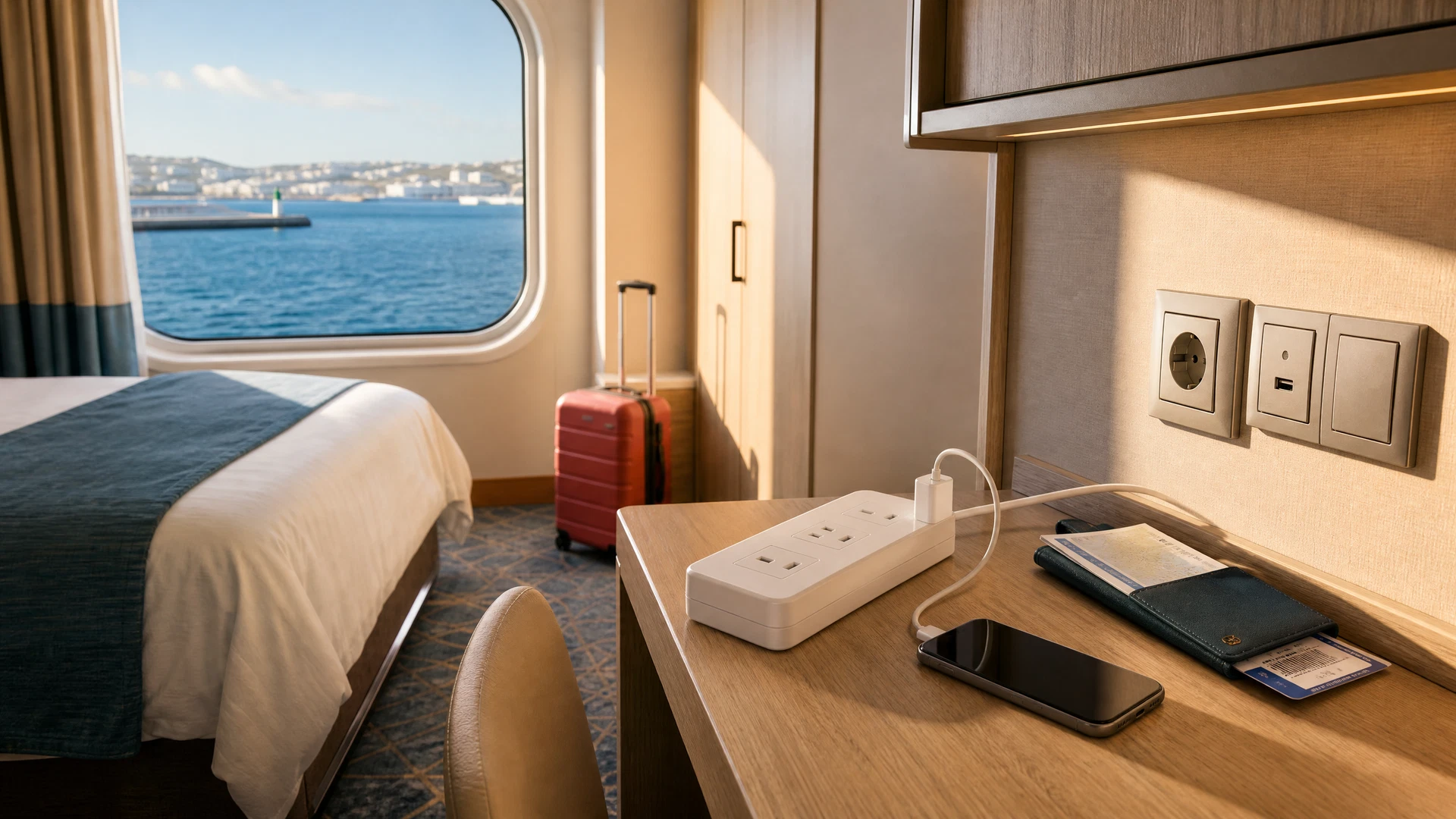
Wondering if you can take an extension lead on a UK cruise? Here’s what cruise lines typically allow, what gets confiscated, safer alternatives, and clear guidance for different traveller types in 2026.
Can you bring an extension lead on a cruise ship UK? It’s one of the most common packing questions from British cruisers because cabins often have limited sockets and families travel with multiple devices. The short answer is: policies vary by line and can change, and many cruise lines either prohibit or strictly control extension leads (especially surge-protected ones). In this 2026 UK-focused guide, we explain what the big lines typically allow, the safest alternatives to pack, how to prepare if you need extra reach for medical equipment, and what to do if security flags your lead at embarkation.
Why extension leads are restricted at sea
Objective facts: Cruise ships run complex electrical systems designed for maritime safety. Multiple high-load devices on one circuit, poor-quality adapters, or surge-protected strips can pose overheating and fire risks. For that reason, many lines restrict or ban passenger-supplied extension leads and power strips, especially those with surge protection, reset buttons, or long cables. Editorial assessment: In practice, enforcement is tight at UK ports. Screening teams commonly remove non-compliant power accessories at the terminal; some items are held until the end of the cruise. Traveller-dependent preference: If you’re relying on extra outlets for convenience rather than a necessity, safer packing alternatives will usually be simpler and avoid hassles at security.
Surge protector vs. plain extension vs. multi-port USB charger
Objective facts: A surge-protected power strip includes components that can interfere with shipboard electrical systems and are widely disallowed. A plain extension lead is a cable that extends one outlet; some lines still ban these because cables can overheat or become trip hazards. A multi-port USB or USB‑C charger converts AC to low-voltage DC and, when used correctly, is typically treated as a standard charger rather than an extension. Editorial assessment: For most UK cruisers, a quality multi-port USB‑C charger is the least problematic way to power phones, tablets and watches without touching restricted accessories.
What UK lines typically say (and why you must re-check in 2026)
Objective facts: Major UK-market lines such as P&O Cruises, Cunard, Marella Cruises, Princess, Royal Caribbean, MSC, Fred. Olsen and Disney publish lists of prohibited or restricted electrical items. These lists frequently include extension cords/leads and surge-protected strips. Some lines may allow a basic, non-surge extension lead after an onboard safety check, and many will supply an approved lead on request for medical devices (for example CPAP). Policies can change without notice; ship class and refits can also affect cabin outlet availability. Editorial assessment: Because wording differs by brand and even by ship, the only reliable approach is to check your line’s official policy shortly before you sail. Traveller-dependent preference: If avoiding uncertainty matters to you, plan to travel without your own extension lead and use safe alternatives listed below.
<table><thead><tr><th>Traveller type</th><th>Pack your own extension lead?</th><th>Better alternative</th><th>Notes (verify with your line in 2026)</th></tr></thead><tbody><tr><td>Solo/minimalist</td><td>No</td><td>1x multi-port USB‑C charger</td><td>Likely enough ports to charge phone + watch overnight.</td></tr><tr><td>Couple with multiple phones/tablets</td><td>No</td><td>GaN USB‑C charger (2–4 ports) + spare USB cable set</td><td>Avoids prohibited strips; keeps sockets free for kettle/hair tools where allowed.</td></tr><tr><td>Family of four</td><td>Usually no</td><td>2x multi-port USB chargers + long USB‑C/Lightning cables</td><td>Split devices across chargers; charge cameras/PowerBanks by day when cabin is cool.</td></tr><tr><td>Content creators/photographers</td><td>Avoid</td><td>USB‑C PD charger + small non-surge power strip ONLY if your line explicitly allows</td><td>Policies vary. If not allowed, plan a charging rota; consider powered USB hub for cameras (if permitted).</td></tr><tr><td>CPAP or medical device users</td><td>Ask your line first</td><td>Request an approved lead from Guest Services/medical team</td><td>Most lines can supply a compliant extension for medical use if pre-arranged.</td></tr><tr><td>Mobility aid users (e.g., scooter)</td><td>Avoid packing your own</td><td>Charge direct to wall; request ship-approved extension if needed</td><td>Inform the line pre-cruise so they can plan safe charging arrangements.</td></tr><tr><td>Long or world cruisers</td><td>Usually avoid</td><td>Dual-voltage USB‑C charger + spare cables</td><td>Reduces confiscation risk across multiple ports/inspections.</td></tr></tbody></table>
Safer alternatives that usually pass muster
Objective facts: Most lines allow low-voltage chargers, standard device cables, and manufacturer-supplied power bricks used as intended. Editorial assessment: The following items reduce the chance of confiscation versus bringing your own extension lead: 1) Multi-port USB/USB‑C GaN charger that plugs directly into the wall; 2) Long USB‑C or Lightning cables (2–3 metres) to reach the bed or desk; 3) A small non-surge, short-cable power strip only if your specific line explicitly allows it (check wording carefully and avoid any with a reset switch); 4) An EU or US adapter only if you need to use non-UK sockets on your ship—avoid adapters that add extra sockets, lights or switches. Traveller-dependent preference: If you frequently use laptops or cameras, prioritise a USB‑C PD charger (e.g., 65–100W class) compatible with your devices. Always keep devices on hard surfaces when charging and never cover with bedding.
- 1–2 multi-port USB‑C chargers (GaN) with mixed USB‑C/USB‑A ports. • 2–4 long USB‑C/Lightning cables clearly labelled by owner. • 1 short UK–EU travel adapter (if needed), without surge or lights. • 1 spare UK fused plug for devices that ship with EU/US bricks. • Cable ties or Velcro straps to keep areas tidy and avoid trip hazards. • Optional: a small, non-surge power strip ONLY if your line’s policy explicitly permits—print or save the policy to show at screening.
Cabin sockets on UK-focused cruise lines: what to expect
Objective facts: Modern UK-market ships often include a mix of socket types (commonly UK 3‑pin and EU/US variants) and, on newer or refurbished ships, one or more USB ports near the desk or bed. However, layouts vary by ship, cabin grade and refit year. Editorial assessment: To reduce frustration, assume you’ll have limited sockets and plan for USB charging where possible. Traveller-dependent preference: If bedside charging is essential to you, pack a long cable so you can keep your device on a hard surface away from pillows.
<table><thead><tr><th>Feature</th><th>Newer ships/modern refits</th><th>Older ships</th></tr></thead><tbody><tr><td>UK 3‑pin sockets</td><td>Often present at desk; sometimes bedside</td><td>Usually at desk only</td></tr><tr><td>EU/US sockets</td><td>Common mix near desk</td><td>May have fewer or none</td></tr><tr><td>Built-in USB ports</td><td>Frequently included</td><td>Not guaranteed</td></tr><tr><td>Bathroom shaver socket</td><td>Usually present (shavers only)</td><td>Usually present (shavers only)</td></tr><tr><td>Space for large plugs</td><td>Better clearance</td><td>May be tight behind desk/lamps</td></tr></tbody></table>
How to charge multiple devices without an extension lead
Objective facts: One efficient charger with multiple USB ports can power several devices simultaneously because it converts AC to low‑voltage DC safely. Editorial assessment: A two-charger strategy works well—keep one at the desk for daytime top-ups and one near the bed (using a long cable) for overnight. Rotate high‑draw items (e.g., laptops, cameras) to daylight hours when you can attend to them.
- Unpack chargers and check outlet locations before plugging in. 2) Use a single wall outlet for each charger to avoid wobble or heat build-up. 3) Keep chargers and batteries on hard, ventilated surfaces—never on bedding. 4) Label each cable so family members can identify theirs. 5) Set a charging rota for high-draw devices (laptops, cameras) in the afternoon. 6) Unplug chargers when not in use, especially on sea days when the cabin warms up in the sun.
Money-saving advice for UK cruisers
Editorial assessment: Buying the right kit at home is cheaper and avoids poor-quality gadgets. Avoid airport or onboard shop panic-buys where selection is limited. Traveller-dependent preference: If you have many USB‑C devices, one higher-wattage GaN charger can replace several individual bricks—lighter, fewer plugs, and no need for an extension lead. Objective facts: Cruise lines may sell adapters onboard, but prices and availability vary and are rarely the best value. If you’re sailing with kids, give each person a colour-coded cable to reduce losses and duplicate purchases.
Buying at home vs onboard
Objective facts: Onboard shops typically carry basics like USB cables and simple adapters, but stock varies by ship and itinerary, and prices are not guaranteed. Editorial assessment: UK high-street or reputable online retailers offer broader choice and better value. If you leave it late, a click-and-collect at the port city is still likely cheaper than shipboard emergency buys. Traveller-dependent preference: If you want a backup, pack a compact spare charger rather than an extension lead—it’s more likely to pass screening and costs less if confiscated is a concern.
Medical and accessibility needs (CPAP, nebulisers, scooters)
Objective facts: Most cruise lines ask guests using medical equipment (e.g., CPAP machines or mobility scooters) to notify them pre-cruise. Many can supply a ship-approved extension lead after risk assessment. Distilled water for CPAP may also be available; request this in advance if needed. Editorial assessment: Ask for written confirmation (email or within your booking notes) and bring a copy to the terminal. Traveller-dependent preference: If your device uses a specific plug type (EU/US), bring the manufacturer-approved adapter, but avoid adding multi-way adapters on top—ask the ship to position equipment safely.
What happens if security flags your extension lead
Objective facts: At embarkation, scanning teams can detain prohibited or uncertain items. You’ll either be asked to surrender the lead for storage until disembarkation or attend an inspection. Some lines allow a safety check for a plain, non-surge lead; others enforce a blanket ban. Editorial assessment: Be polite, show your printed policy, and have a backup plan (e.g., multi-port chargers). Traveller-dependent preference: If you really need reach to a bed for medical reasons, request the ship’s approved lead via Guest Services rather than trying to pass your own through screening.
Are cube adapters and tower blocks allowed?
Objective facts: Many lines treat tower blocks and cube adapters as high-risk due to weight, wobble and surge components; they’re often confiscated. Editorial assessment: Even if your cube says “no surge,” it may still be refused. A basic, multi-port USB charger is a safer bet. Traveller-dependent preference: If bedside outlets are important, prioritise a long, good-quality USB cable over any kind of multi-way mains device.
Hair straighteners, curlers and kettles
Objective facts: Hair straighteners and curlers are generally permitted when used safely, but personal kettles, irons and garment steamers are typically prohibited. Always check your line’s list. Editorial assessment: Don’t plug heat tools into adapters or multi-way devices; use a wall socket and let them cool on a heat-safe surface. Traveller-dependent preference: If you need a kettle, choose a line or cabin grade that provides one rather than packing your own.
Our 2026 packing recommendation for UK cruisers
Editorial assessment: For most travellers sailing from the UK in 2026, do not pack your own extension lead. Instead bring one or two quality multi-port USB‑C chargers and long charging cables. If you rely on a CPAP or have an accessibility need, arrange an approved ship-supplied extension lead in advance and bring a printout or screenshot of the confirmation. Objective facts: This approach aligns with the broadly restrictive policies on passenger-supplied extension leads and reduces the likelihood of embarkation delays or confiscation.
Useful next reads on MyCruiseAdvisor
Plan the rest of your packing and cabin setup with these UK-focused guides: • Power outlets and charging explained: Cruise cabin plugs and USB ports • What not to bring: Things cruise lines ban (UK guide) • CPAP at sea: Using a CPAP machine on a cruise • Smart packing: What to pack for a UK cruise • Gadgets that help (and are allowed): Useful cruise cabin gadgets • Family prep: Cruise packing list for families • First-time nerves: Cruise embarkation tips UK
Sources and verification
Always verify the latest rules directly with your cruise line in 2026, as policies can change. Official policy and FAQ hubs: • P&O Cruises UK: https://www.pocruises.com/help-and-faqs • Cunard Line UK: https://www.cunard.com/en-gb/frequently-asked-questions • Marella Cruises (TUI): https://www.tui.co.uk/cruise/faqs • Royal Caribbean: https://www.royalcaribbean.com/faq/topics/prohibited-items • Princess Cruises UK: https://www.princess.com/en-gb/faqs • MSC Cruises UK: https://www.msccruises.co.uk/help/faq • Fred. Olsen Cruise Lines: https://www.fredolsencruises.com/faqs • Disney Cruise Line: https://disneycruise.disney.go.com/faq/prohibited-items/
Frequently Asked Questions
Are any extension leads allowed on cruise ships from the UK?
Policies vary. Many lines prohibit extension leads—especially surge-protected strips. Some may permit a basic, non-surge, short lead after inspection, or will supply an approved lead for medical use. Check your cruise line’s official policy shortly before you sail in 2026.
Do cruise lines allow surge-protected power strips?
Surge-protected strips are widely disallowed because they can interfere with the ship’s electrical systems and increase fire risk. Expect them to be confiscated during screening.
What should I pack instead of an extension lead?
Bring one or two quality multi-port USB/USB‑C chargers and longer device cables. If you need more mains sockets and your line explicitly allows a non-surge strip, keep it short and simple—no reset switches—and print the relevant policy page.
Can I get an extension lead onboard for my CPAP?
Most lines can provide a ship-approved extension lead for medical equipment if requested in advance. Contact your cruise line’s accessibility or medical team at least two weeks before sailing and carry their confirmation to the terminal.
Will my extension lead be returned if it’s confiscated?
In many cases, yes—held until disembarkation. Procedures vary by line and port. You may be asked to collect it at the end of the cruise. If in doubt, don’t bring it.
Are cube adapters and tower blocks permitted?
They are commonly treated as prohibited or high risk due to weight, wobble, and surge components. Even if labelled non-surge, they may still be refused. Opt for a multi-port USB charger and long cables instead.
Do UK cruise cabins have USB ports?
Many newer or refurbished ships include USB ports, typically by the desk and sometimes bedside, but it’s not guaranteed. Bring a multi-port USB charger and long cables as a backup.
Can I use a laptop charger onboard?
Yes, manufacturer-supplied laptop chargers are typically allowed. Plug them directly into a wall socket (or into a non-surge strip only if your line explicitly permits it) and keep the area ventilated while charging.